



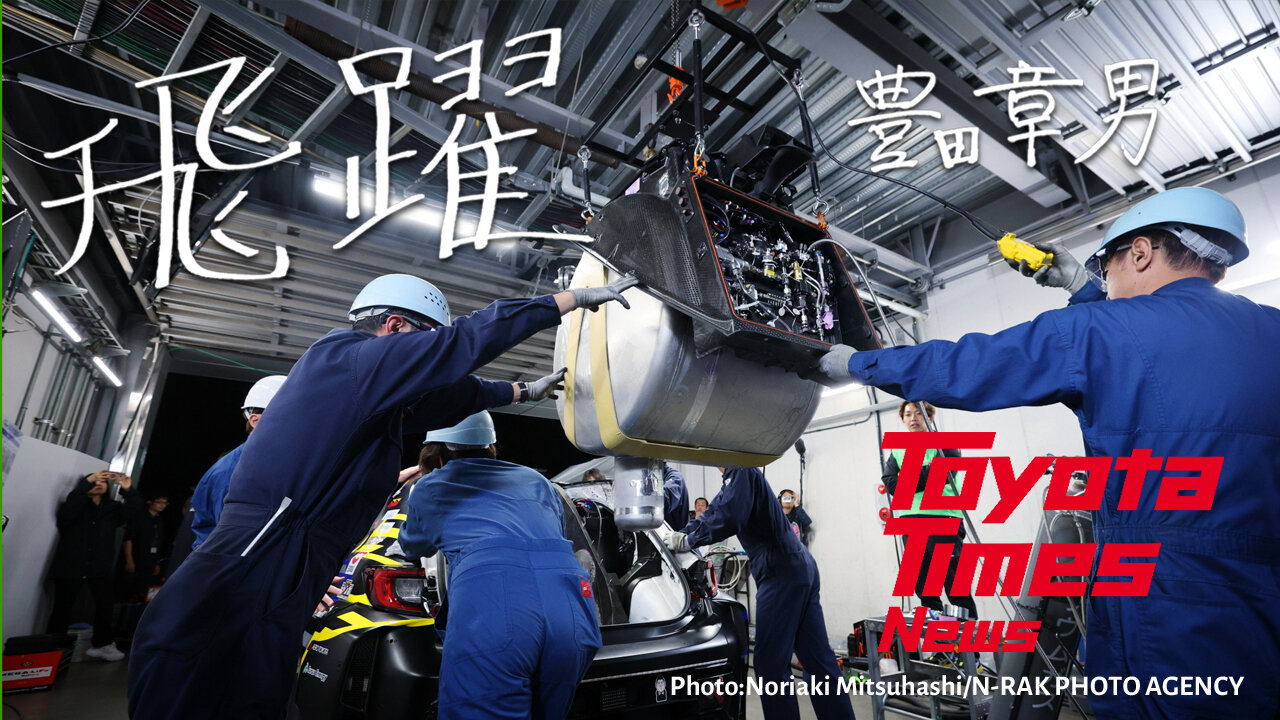
Once again in 2026, the hydrogen-powered GR Corolla joined in the Super Taikyu Fuji 24 Hours. This year, it became the first race car in the world to compete with a superconducting liquid hydrogen pump onboard.
“Our journey toward the future, now in its 6th year, is just beginning.”
Morizo, also known as Chairman Akio Toyoda, delivered this message to his team before Round 3 of the Super Taikyu Fuji 24 Hours race.
In the sixth year of its hydrogen-engine challenge, the team introduced a racing world-first: a superconducting liquid hydrogen pump.
By taking advantage of liquid hydrogen's ultra-low temperature of -253°C, the conventional electric motor used to pump the fuel was replaced with a smaller, higher-performance superconducting motor.
Placing the motor inside the tank rather than on top increases tank capacity, doubling the volume of liquid hydrogen compared to the first tank. Eventually, this will enable the car to achieve a driving range comparable to that of gasoline-powered vehicles.
However, superconductors are usually used in stable, low-vibration environments.
“Using a superconducting motor in a race car is almost unthinkable.”
Kyoto University professor Taketsune Nakamura, who assisted with the development, emphasized the difficulty of using the motor in the vibration-heavy environment of racing.
Toyota Times News followed this development closely.
The mechanics, engineers, drivers, and others came together as a team to overcome the challenges one at a time.
Would the hydrogen-powered GR Corolla make it to the checkered flag? And what challenge was Morizo taking on during this race?