



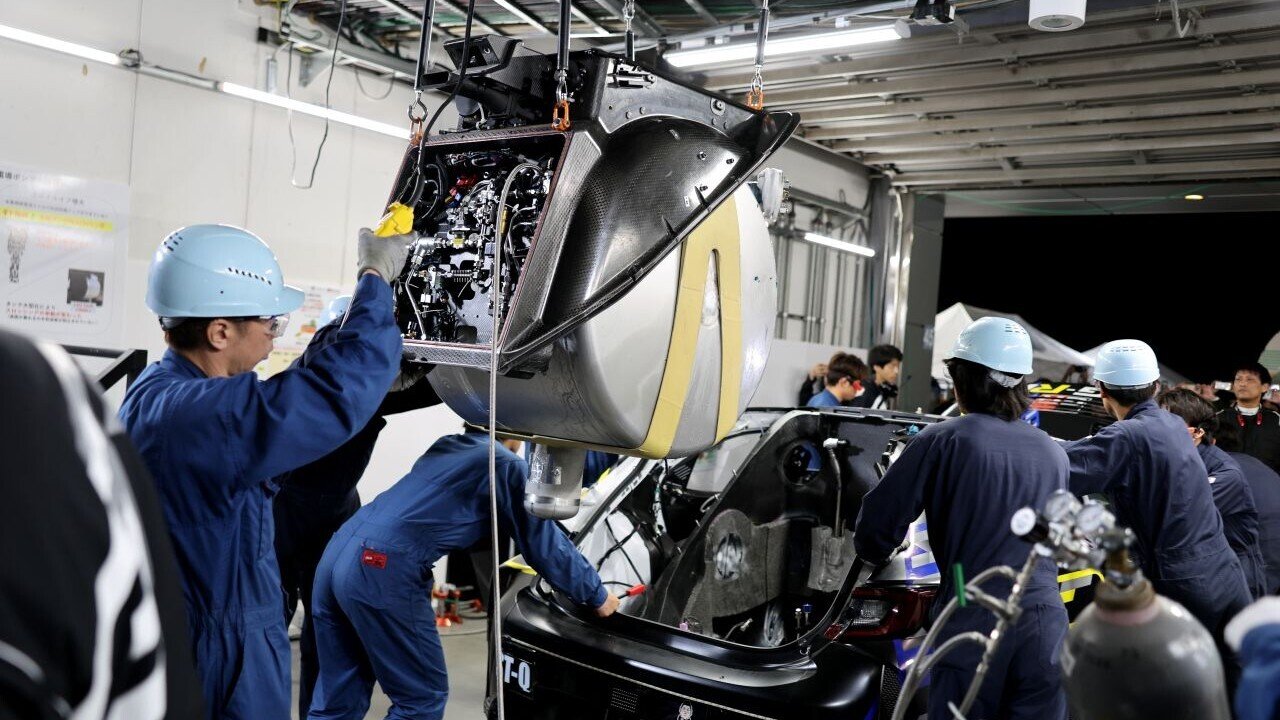
The 2026 Super Taikyu Fuji 24-hour race saw Toyota competing with a hydrogen engine for the sixth straight year. This time, the team took on the world's first challenge using superconducting technology.
Round 3 of the Super Taikyu Series, the Fuji 24 Hours, was held at Fuji Motorsports Forest from June 5 to 7.
Being Japan’s only 24-hour race, the event generates a great deal of excitement, and this year drew a crowd of 64,900 fans.

Since 2021, Toyota has been taking on Super Taikyu in the hydrogen-engine GR Corolla.
With the company looking to use hydrogen engines in future production vehicles, the series has provided a platform for continued technical development.

In the hydrogen-engine Corolla’s sixth year at Fuji, the team completed a record-high 483 laps.
A major factor behind this achievement was a new addition introduced this year: a superconducting liquid hydrogen pump.
After announcing the concept in May 2023, Toyota unveiled the technology at the Super Taikyu season finale in November 2025. Now, in a world first, the superconducting liquid hydrogen pump has been incorporated into a racing car.
In terms of performance, the technology appeared to be a significant step forward, with one driver commenting, “It’s wonderful to be able to have the same dialogue as with a gasoline car, and to focus entirely on the driving setup.”
We take a detailed look at the new pump, along with the challenges that revealed themselves on the racetrack.
A great fit for liquid hydrogen engines
Superconductivity is a groundbreaking technology based on superconductivity, a phenomenon in which electrical resistance drops to zero at ultralow temperatures, enabling current to flow without energy loss.
What drew the team to this technology was a special characteristic of the hydrogen engine GR Corolla’s fuel.
The temperature of the liquid hydrogen fuel used for racing is -253°C.
This extremely low temperature presents an ideal environment for superconductivity.
So what advantages does a superconducting liquid hydrogen pump bring?
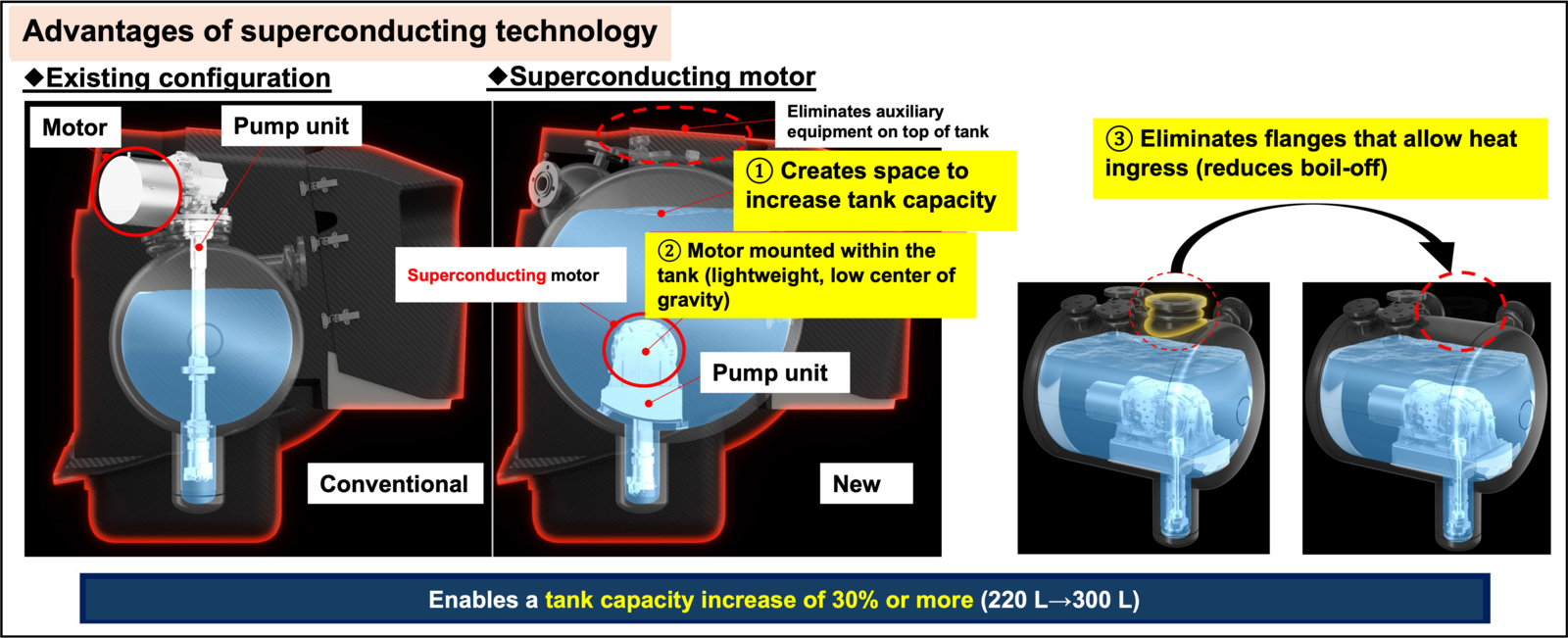
The biggest benefit is increased fuel tank capacity (① in the figure above).
Whereas previously the motor and other peripheral components were placed outside of the tank, the motor is now housed inside because it must be placed within the ultralow-temperature liquid hydrogen.
This move created additional space, allowing engineers to expand the tank’s capacity by 30% or more.
Superconductivity also enables a more compact and lightweight motor, while housing the motor inside the fuel tank lowers the car’s center of gravity, improving driving stability (②).
What’s more, by doing away with flanges that previously allowed heat to enter the system, the new configuration promises to improve fuel efficiency by reducing the amount of hydrogen that warms up and vaporizes inside the tank, known as boil-off (③).
Naoaki Ito, the GR Vehicle Development Division Project General Manager overseeing the hydrogen engine project, spoke about the superconducting pump in the context of the team’s efforts to date.
Project General Manager Ito
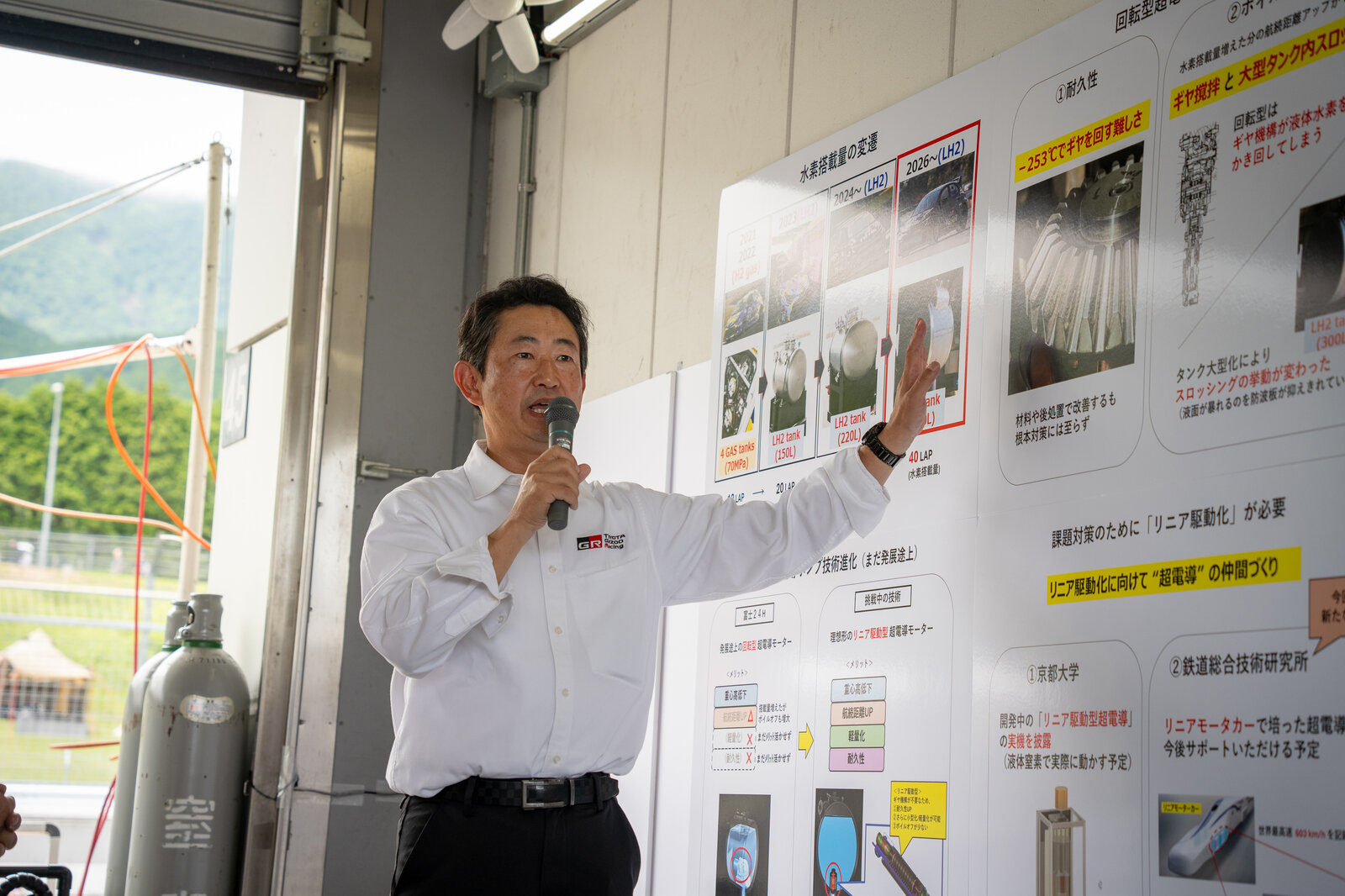
This is our sixth year racing with the hydrogen engine, and our goal has always been to catch up with gasoline-powered cars.
The gasoline GR Yaris can run about 40 laps on a full tank, but until now with the liquid hydrogen Corolla, our packaging limited us to 30 laps at most.
For this race, we used superconducting technology and moved the pump into the tank, which allowed us to expand the tank so that it now carries enough liquid hydrogen for 40 laps.
At first, the motor wouldn’t turn at all. From that starting point, the task was tremendously challenging, but we were able to advance development to the stage where it can perform reliably on the racetrack.
However, this doesn’t directly translate into running 40 laps like a gasoline-fueled car. It’s not quite that simple, and many hurdles still exist.
The biggest challenges are durability and increased boil-off.