


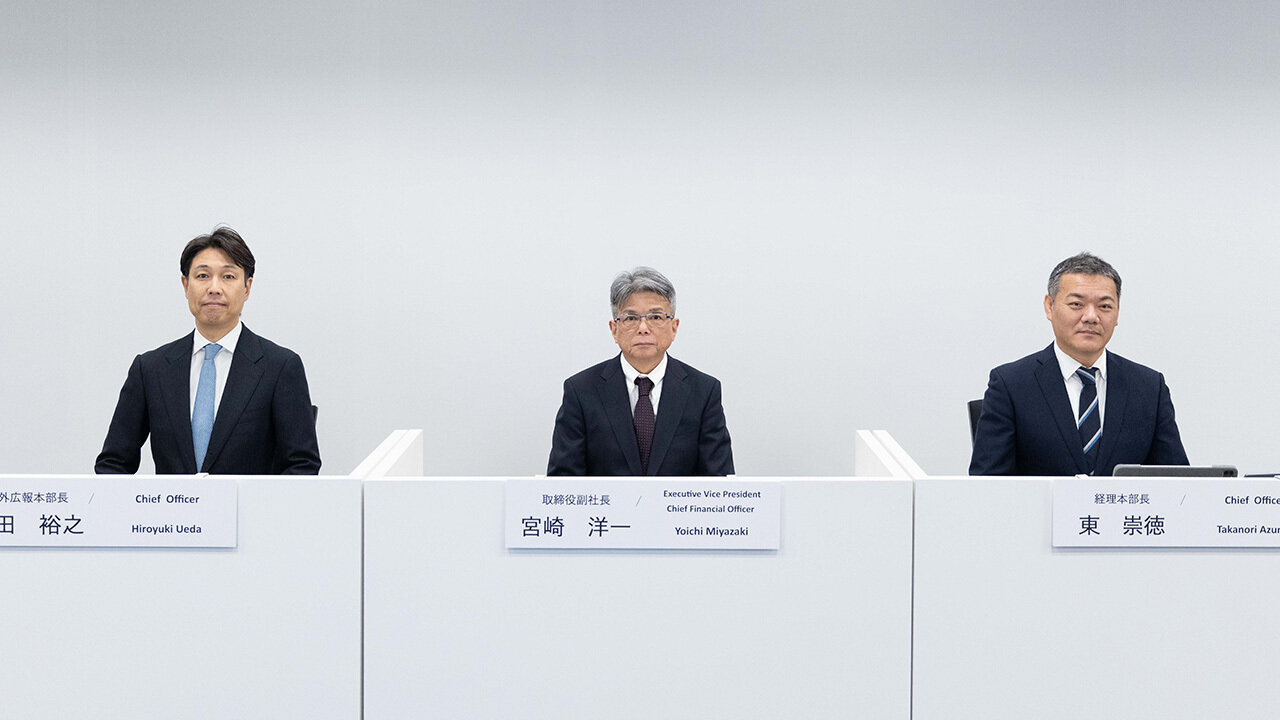
Toyota's financial results for the second quarter of FY2027 showed a year-on-year increase in profit for the first time in three years. We break down Vice President Yoichi Miyazaki's explanations, as well as the outlook for the company's structural reforms.
[New domains] Toyota Robotics to become a new pillar
Toyota is laying the groundwork for its transformation into a mobility company by exploring new business domains. In addition to its cutting-edge in-house development, Toyota works with emerging, growing, and mature startups through Woven Capital, Toyota Ventures, Toyota Invention Partners, and external funds, looking to establish new growth pillars beyond the automotive sector.
Through a funding framework of 510 billion yen, Toyota is seeking out promising technologies and business opportunities around the world, spanning AI, space, and innovative energy technologies. It is currently partnering with more than 100 companies.
These also include the field of robotics, where commercialization efforts are accelerating.
For Toyota, robotics is chiefly about “expanding human potential.” Vice President Miyazaki explained the company’s approach.
Vice President Miyazaki
AI and robots exist not to replace humans, but to enhance human capabilities.
The same holds for our robotics business, in which we aim to contribute to a richer quality of life by supporting those who act or take on challenges for the sake of others.
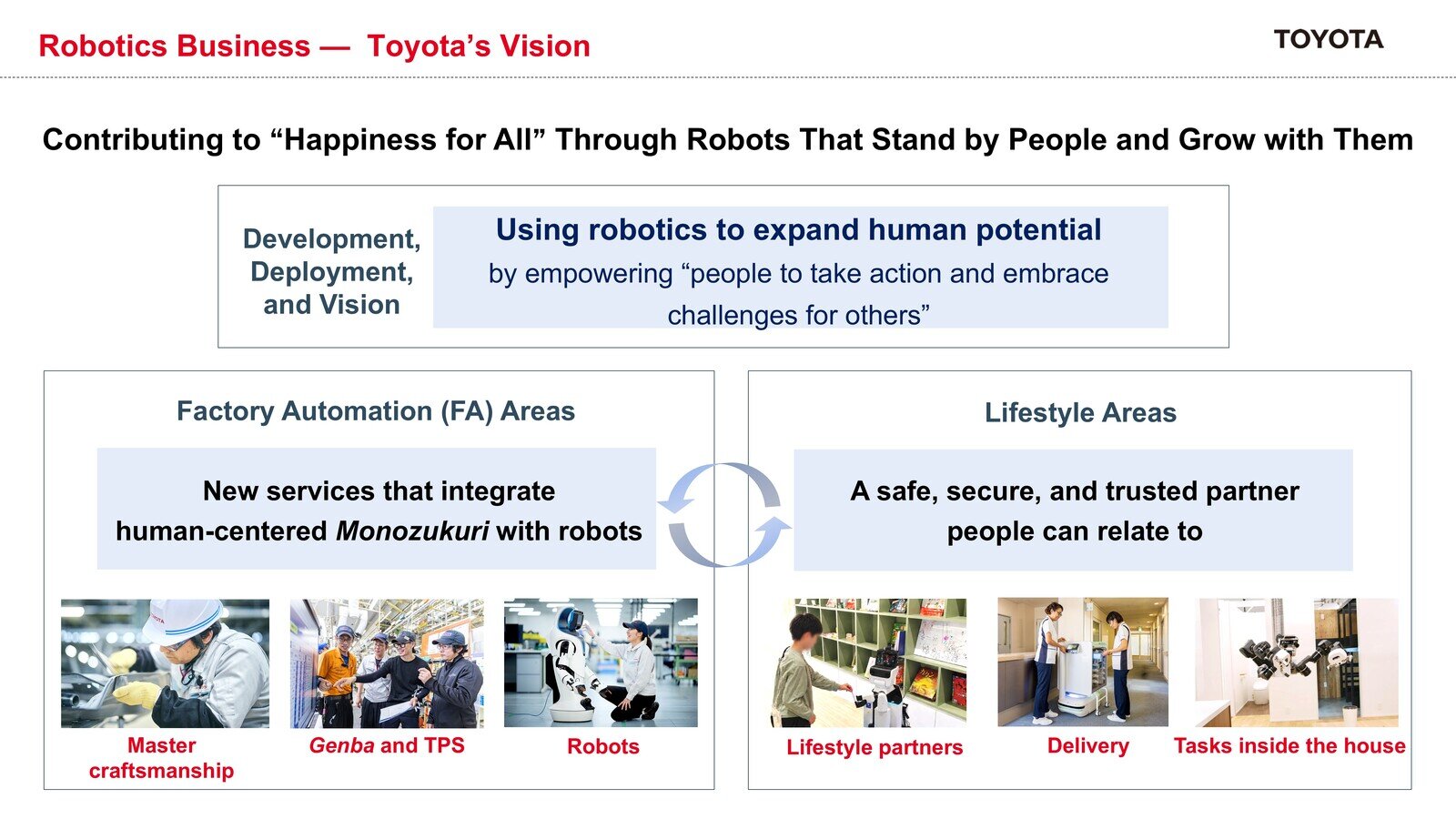
In factory automation, we are integrating robotics and AI technologies with our expert skills and the Toyota Production System, enabling people and robots to learn from and assist one another. We aim to make this new approach to manufacturing a reality.
Furthermore, we will accelerate the deployment of robots at Woven City and extend the skills and insights honed at our plants to lifestyle domains.
From our plants to our everyday lives, we aim to produce happiness for all through robots that are close to people and grow alongside them.
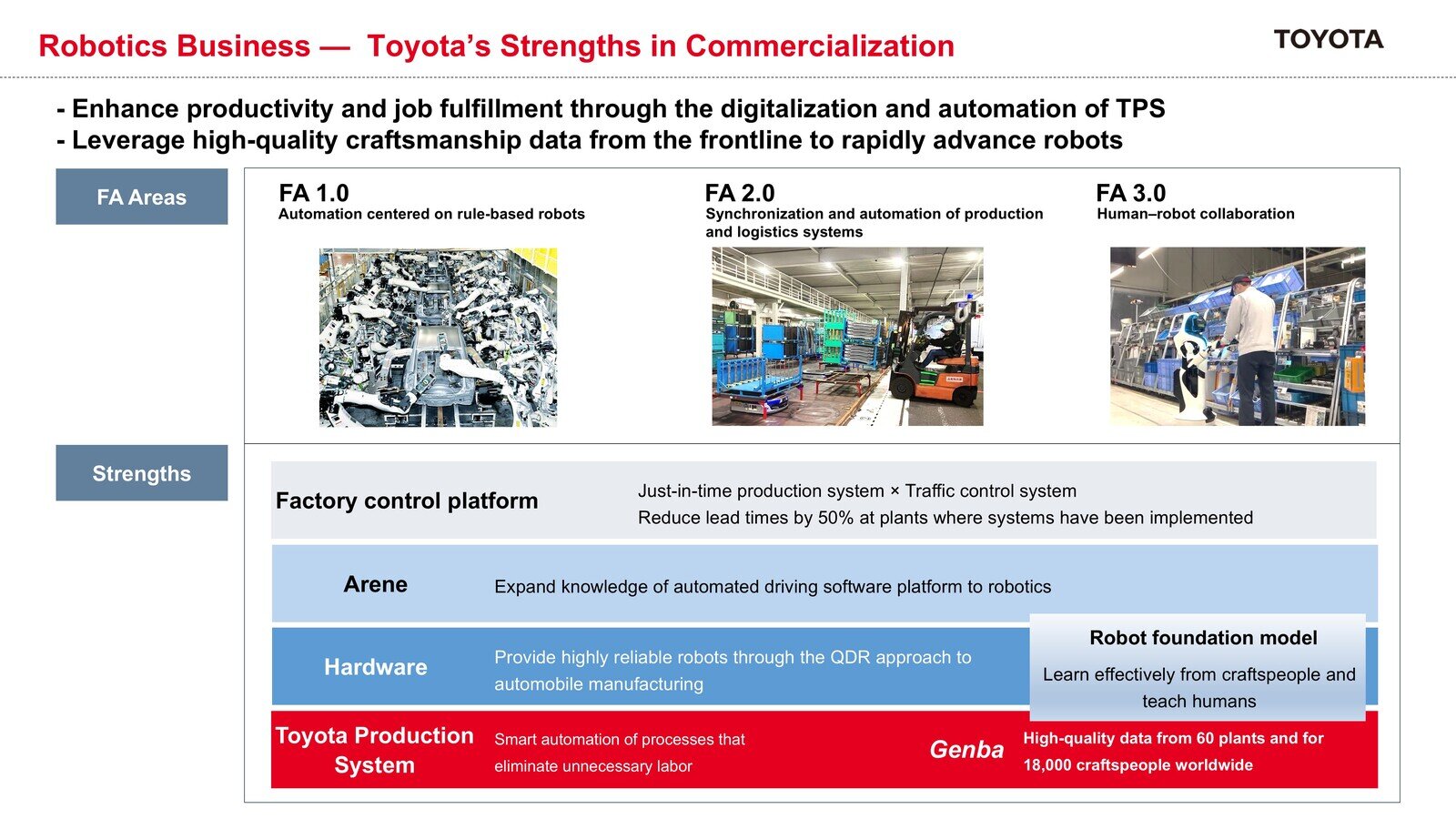
In the field of robot-driven factory automation, Toyota’s strengths lie in its factory control platform, Arene*, hardware, its robot foundation model, the Toyota Production System, and the genba.
*A platform that accelerates vehicle software development.
Moving toward commercialization, Toyota will first hone its robotics through internal use within the group and suppliers, before selling externally to other industries and lifestyle domains.
Internal factory automation investment is expected to involve the deployment of a cumulative 400,000 robots and around 1 trillion yen annually to replace aging equipment. Vice President Miyazaki intends to turn these outlays from costs into a business development opportunity.
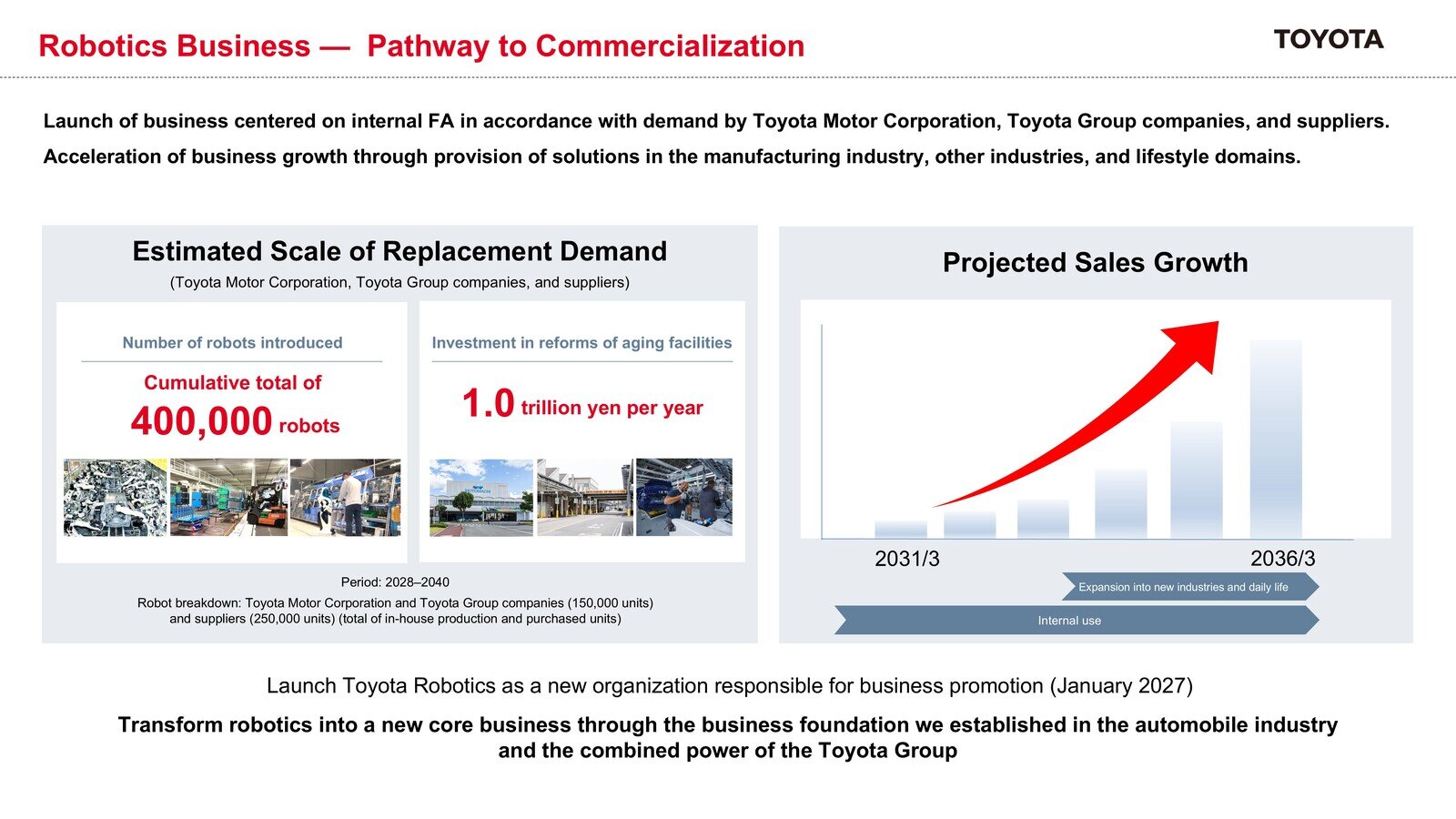
A new company-wide organization, Toyota Robotics, will be established on January 1, 2027, with the aim of growing its sales from 2030 onward.
[Capital strategy] Balancing growth investment and returns
One key financial indicator used to assess a company’s profitability and management efficiency is Return on Equity (ROE).
For Toyota, ROE also serves as a metric for gauging the progress of its transformation into a mobility company.
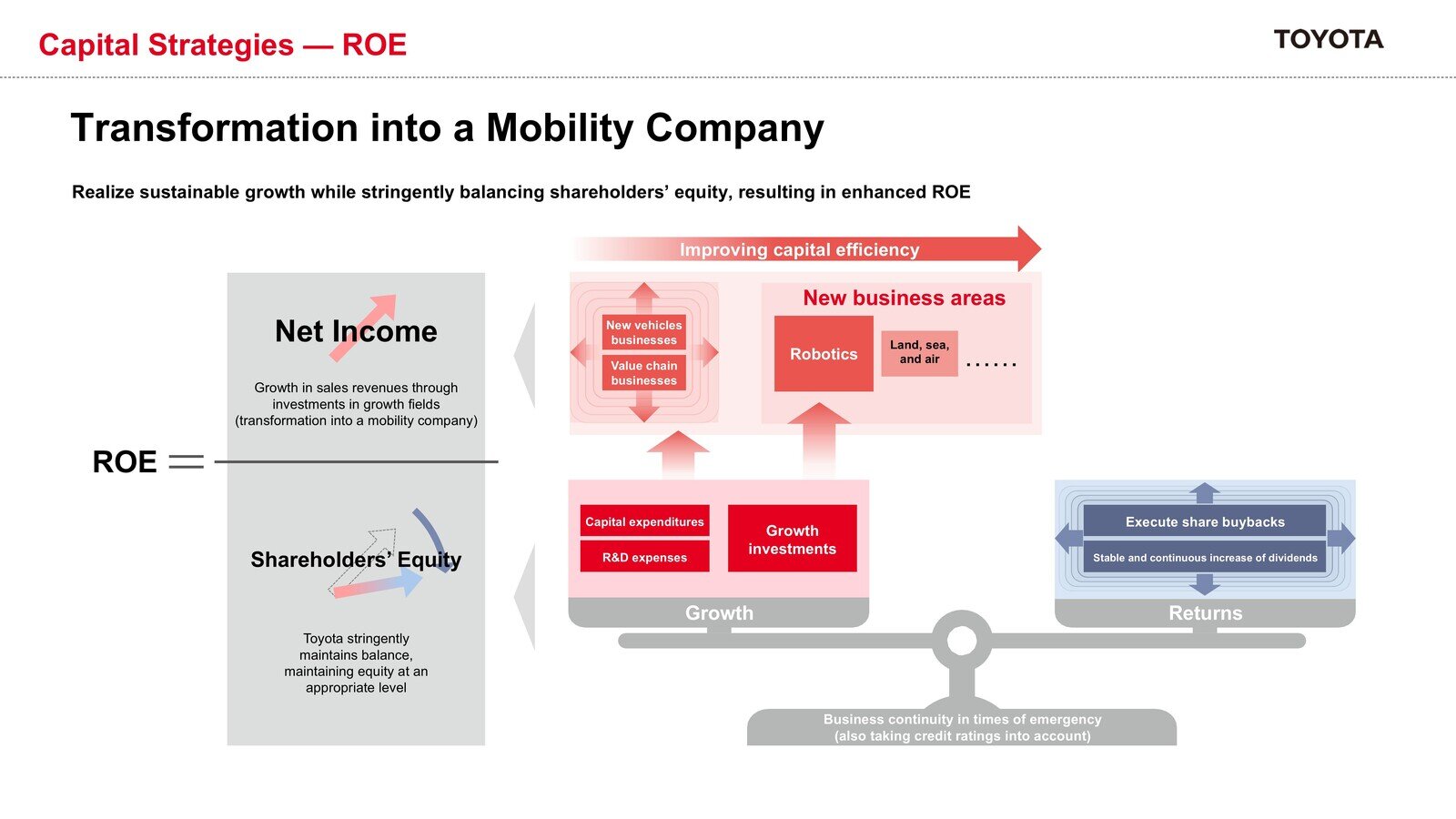
On the earnings side—the numerator of ROE—Toyota aims to generate greater returns from its new vehicle and value chain businesses, while leveraging existing technologies and assets to achieve even greater returns in robotics.
For the denominator (shareholders’ equity), as noted in the financial results, Toyota is committed to rewarding long-term shareholders through stable and continuous dividend increases, while also undertaking flexible share buybacks.
Over the five years to March 2026, out of a total 38 trillion yen, Toyota allocated 16 trillion yen to capital expenditures and R&D expenses, and 7 trillion yen to shareholder returns.
Over the next five years, the company plans to set aside 7 trillion yen as a contingency reserve, allocate 22 trillion yen to capital expenditures and R&D, and 11 trillion to 14 trillion yen for shareholder returns. Funds will also be earmarked for growth investment.
Inspiring optimism
These are some of the efforts being undertaken by Toyota as part of its business structure reforms.
Finally, we would like to share a moment from the Q&A session in which Vice President Miyazaki, speaking from his own experience, explained what Toyota hopes to achieve by providing such detailed briefings.
Vice President Miyazaki
Since taking on the role of CFO (Chief Financial Officer), my conversations with stakeholders have made me realize that we need to make a greater effort to help people properly understand Toyota’s long-term growth prospects and potential, and to give them a sense of excitement and optimism that makes them want to support the company.
We have also discussed the importance of continuing to share information so that people can remain confident that Toyota is on the right track.
This briefing is a first attempt to adjust our communication based on those lessons.
To be honest, I’m a little nervous to see what kind of feedback and comments you will provide.
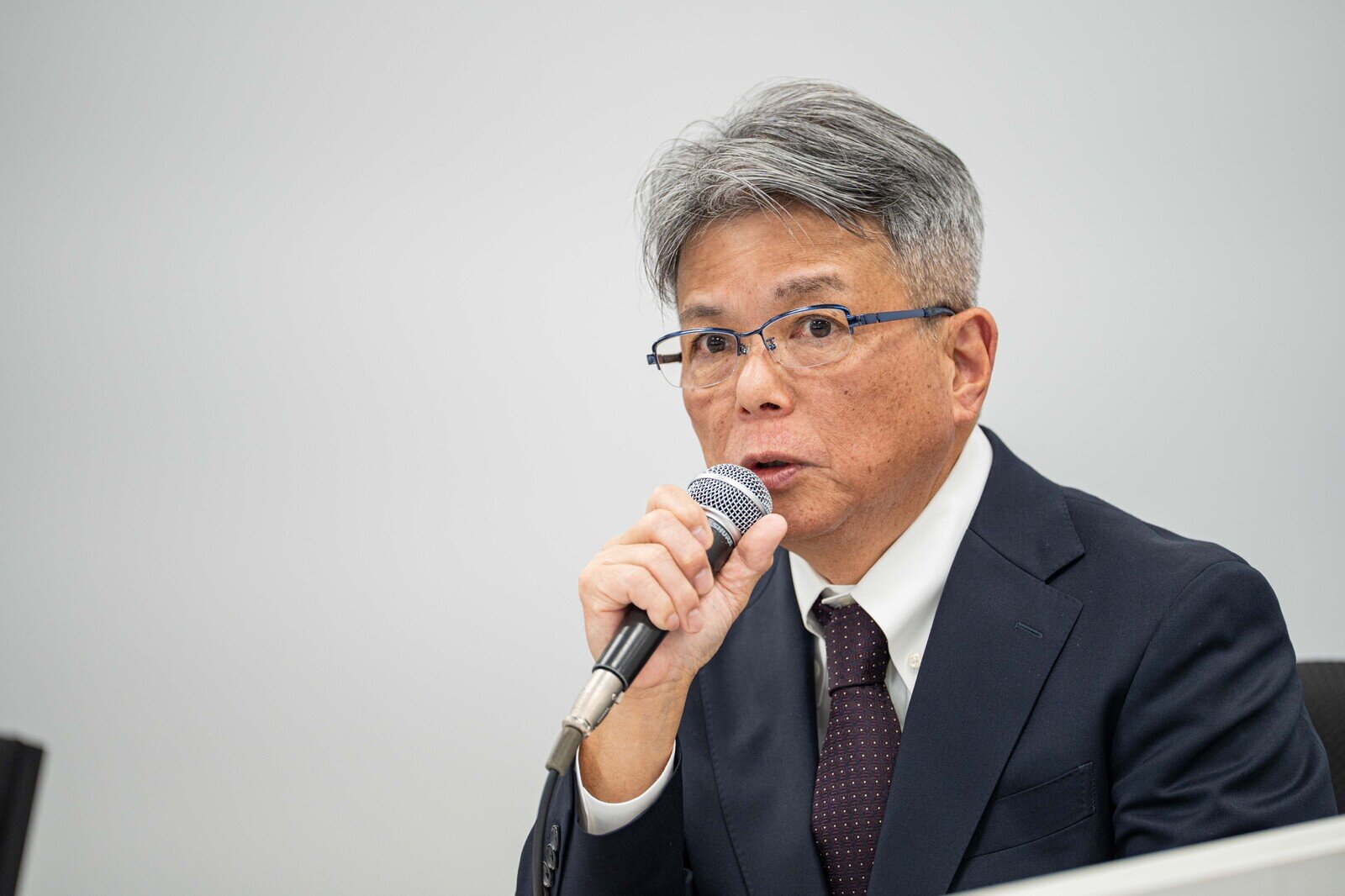
Before becoming CFO, I had built my career in sales, where I tended to focus on increasing revenue and profits.
In this position, however, I have become keenly aware that I must pay close attention to not only the profit and loss statements, but also the balance sheet indicating our financial foundations.
This perspective has helped fuel more in-depth discussions about how to achieve future growth and improve capital efficiency, and I wanted to share that today.
Of course, since we operate in a competitive market, there are certain things we cannot disclose. Nevertheless, we will continue to communicate our mindset and provide updates on our initiatives, as we seek to become a company that inspires optimism and support.
Remaining attuned to the voices of stakeholders, Toyota will continue to share the journey of its transformation into a mobility company.