




Toyota posted broadly steady results, pairing the announcement with a major open-market share repurchase.
On August 4, 2026, Toyota announced its financial results for the first quarter of the fiscal year ending March 2027. The results and subsequent briefings highlight how the company intends to balance shareholder returns with continued, aggressive investment in growth.
Upgraded Financial Outlook: FY2027 Forecasts and Q1 Performance
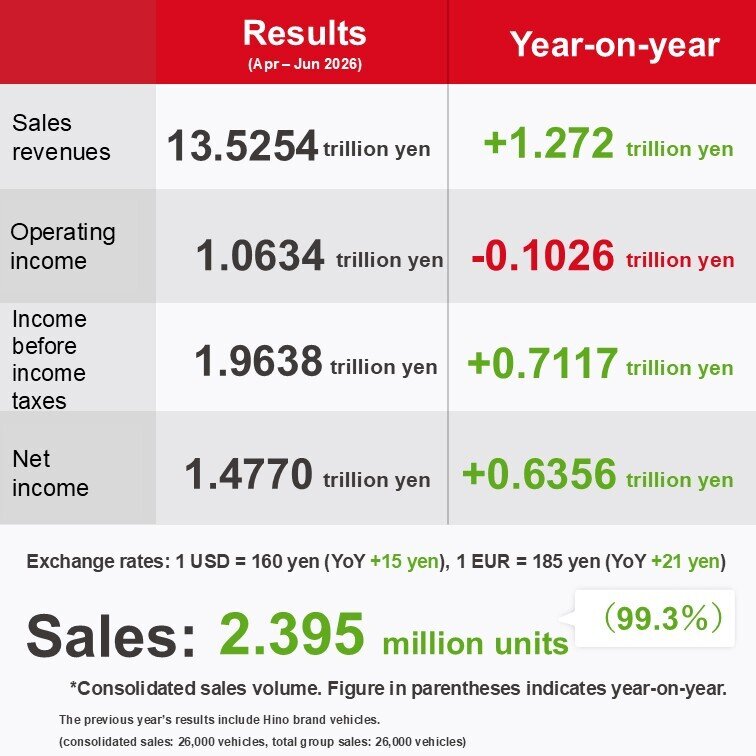
Despite the impact of the situation in the Middle East, Toyota maintained Q1 performance broadly in line with the previous year, supported by foreign exchange effects, cost reductions, expanded value chain earnings, and increased hybrid electric vehicle (HEV) sales. Operating income for the April to June quarter came in at 1.0634 trillion yen (approximately 6.76 billion USD*), 102.6 billion yen (651.8 million USD) lower than the same period last year.
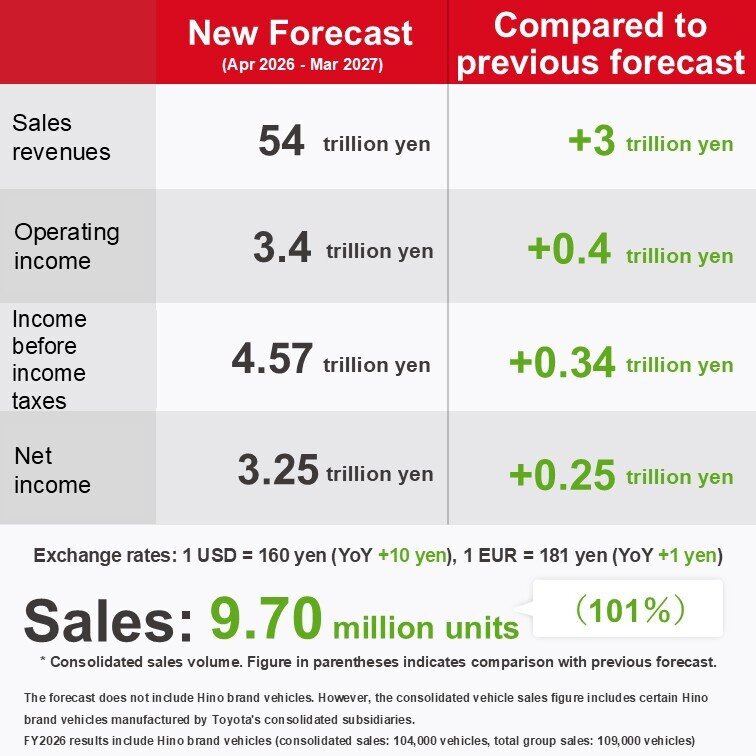
Looking ahead, the full-year operating income forecast for fiscal 2027 was raised by 400 billion yen (2.54 billion USD) to 3.4 trillion yen (21.6 billion USD). This update factors in a sales recovery enabled by alternative logistics routes to the Middle East, efforts to strengthen the value chain business, and other operational improvements.
*All USD conversions at a rate of 157.4 yen to the dollar and as of August 4, 2026
Deepening Dialogue with the Market: 1 Trillion Yen Share Repurchase and ROE Targets
To improve market supply and demand and increase the value of each share, Toyota announced an open-market share repurchase of up to 1 trillion yen (6.35 billion USD), to be conducted between August 5, 2026, and August 4, 2027. To avoid holding an excessive amount of its own stock, Toyota also decided to cancel 200 million shares, equivalent to 1.37% of its issued shares, alongside the repurchase.
While Toyota has been working to strengthen competitiveness and improve earning power by leveraging its strong foundation in products, business operations, and finances, the company acknowledges there remains considerable room to improve its standing with investors. Guided by the belief that “the auto industry is a collective effort,” Toyota carefully considered how best to return value to its diverse stakeholders—including shareholders, local communities, suppliers, dealers, and employees—and decided on the share repurchase for its first-quarter announcement.
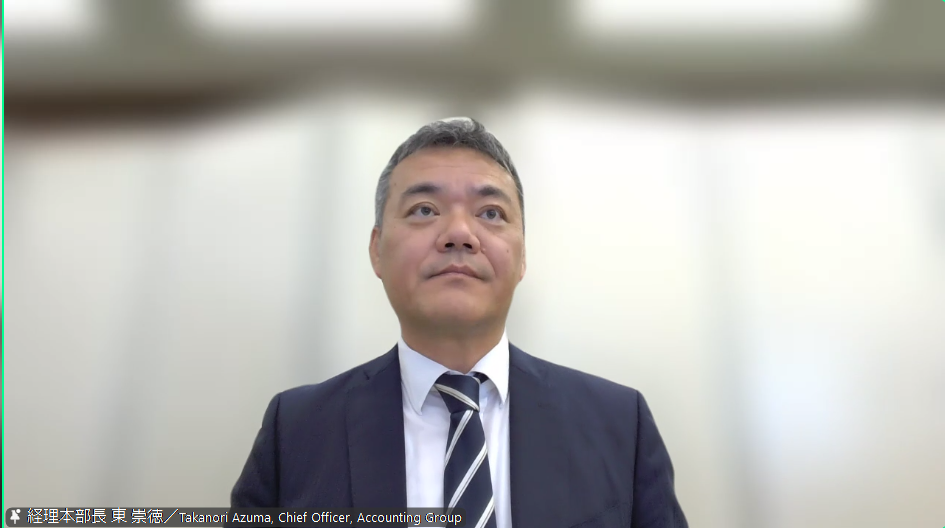
Speaking at an online results briefing for investors on the day of the announcement, Accounting Group Chief Officer Takanori Azuma explained the purpose of the share repurchase:
"Given current stock market conditions, our intention is to show our commitment to providing solid returns. Many people own Toyota stock, including individual shareholders and funds, as well as a large number who hold it through their pension assets. ... Having sought out various opinions on how we can provide returns to our investors and shareholders, we have identified diverse needs, including for share repurchasing and stable, sustained dividend increases. Rather than relying on a single method, we want to deliver returns through a combination of approaches. Going forward, we will continue to reassess our efforts and strategies through close dialogue with the market."
The share repurchases and ongoing growth investments are made possible by the strength of Toyota’s products, underpinned by ever-better carmaking, as well as its robust cash generation and financial foundations. Building on these foundations, Toyota is looking to accelerate its transformation into a mobility company, using a Return on Equity (ROE) of 20% as a yardstick.
When asked for his thoughts on these measures during the dialogue with investors, Chief Officer Azuma responded as follows:
"On the denominator (equity) side of the equation, in the past few years we have significantly reduced our cross-shareholdings. Together with such adjustments, we will continue to evaluate our approach to share repurchasing and dividends. On the numerator (income) side, we’re working to expand hybrid vehicle capacity, expand value chain earnings, and pursue initiatives in the field of robotics by leveraging our expertise across the Toyota Group."
Accelerating Growth Investment: HEVs, Next-Generation Batteries, and Global Restructuring
Even as it seeks to boost capital efficiency, Toyota has no intention of slowing down the pace of growth investment. As indicated in May’s FY2026 full-year financial results announcement, the company is steadily investing to strengthen its earning power and establish a sustainable growth trajectory.
A primary focus is expanding production capacity to meet growing HEV demand. In the April-June quarter, electrified vehicles made up 55.3% of Toyota and Lexus sales, with a large majority being hybrids. Over the full year, the company expects HEV sales to top 5 million for the first time.
To meet this strong demand, Toyota plans to increase supply capacity while further enhancing performance and cost competitiveness. In Japan, production lines with capacity for around 600,000 vehicles will be converted to support next-generation batteries between 2027 and 2028. The company is also considering further capacity expansion toward 2030.
Another core initiative is restructuring its production lineup to establish competitive, locally based production systems that can flexibly accommodate regional demand. On July 7, Toyota Motor North America announced an additional $3.6 billion investment in its Texas plant, which produces the Toyota Tacoma. Toyota will also construct two new plants in India, where future demand growth is expected, alongside other efforts to strengthen regional supply systems.
To fulfill its commitment to “balancing growth and returns, while standing together with our many stakeholders,” Toyota will continue pursuing its own path toward sustainable growth.