



An icon. A legend. It will never let you down. The Land Cruiser turns 75 this year, and with the addition of the Land Cruiser FJ and a hybrid powertrain, its journey is far from over.
“The history of the Land Cruiser is, in many ways, the history of Toyota itself,” said Simon Humphries, Chief Branding Officer (CBO), at the 2023 world premiere of the Land Cruiser 250.
Born in 1951, just 14 years after the founding of Toyota the Land Cruiser predates both the Crown and the Century – two models also associated with the history of the company. Shaped and strengthened by customers around the world, it has continuously inherited and evolved its reliability, durability, and off-road performance, supporting people’s lives and livelihoods in more than 190 countries and regions. It has earned the reputation of a vehicle that can go anywhere and come back alive.
Today, three lineages of the Land Cruiser still travel the globe, on and off-road: the Station Wagon, represented by the 300 Series, the Light Duty, represented by the 250 Series, and the Heavy Duty represented by the 70 Series. In 2026, the Land Cruiser FJ branched off the Light Duty family, while the 300 became the first Land Cruiser in Japan to be offered with a hybrid electric vehicle (HEV) powertrain.
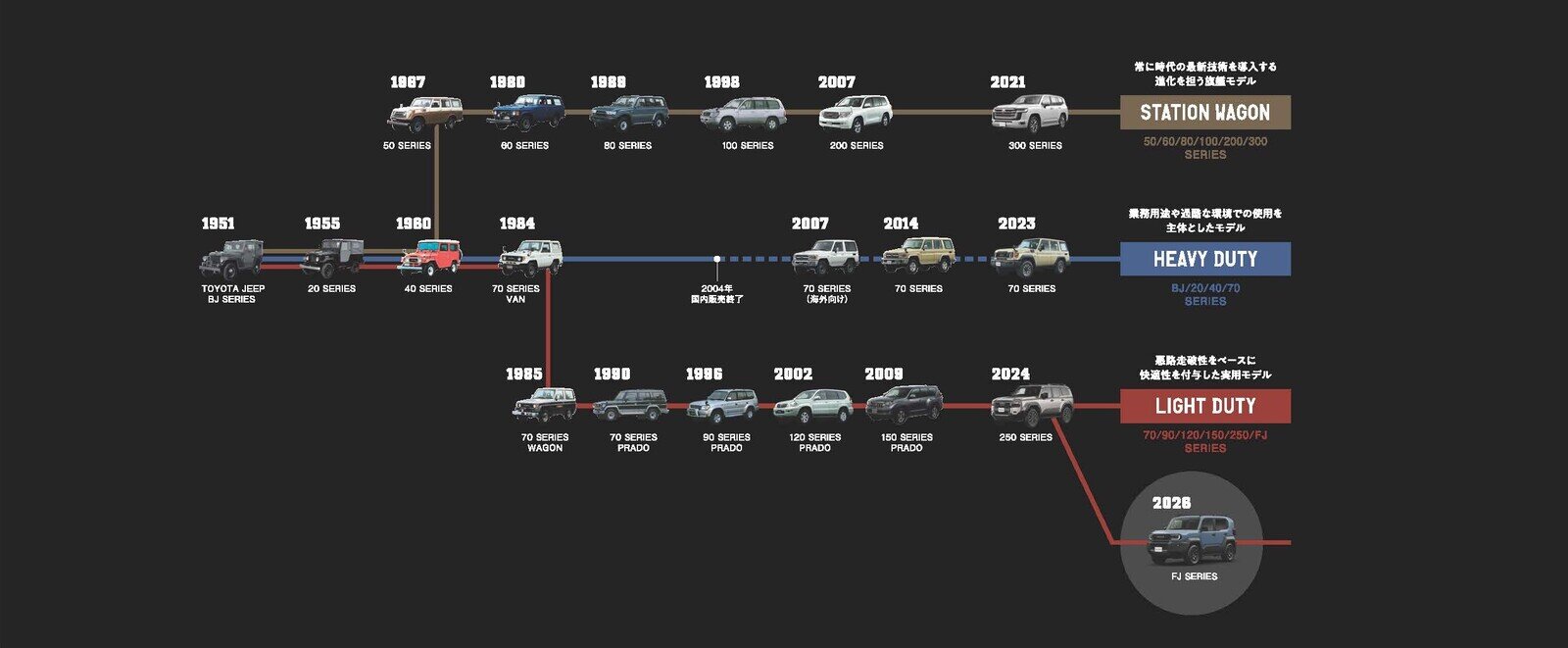
As the Land Cruiser becomes a vehicle that fits into the lives of an ever-wider range of customers, tracing its history reveals a single enduring mission.
Going Back to the Land Cruiser’s Roots
Back when the current 250 was developed, TMC Chairman Akio Toyoda had given the development team a clear mission: go back to the Land Cruiser’s roots. Humphries explained how the team understood that direction at the time.
Simon Humphries, CBO
Akio was giving the development team a chance to hit the reset button. It was an opportunity to reconsider the role of the Land Cruiser within Toyota’s portfolio and rediscover its true value. The aim was to bring that value into focus and create a vehicle that could serve as a foothold for the future.
It was a chance to clarify the unwavering convictions at the heart of the Land Cruiser. The result transcends trends and has become a vehicle in which customers around the world can place their unconditional trust.
Developing a new model was important, but everyone involved with the Land Cruiser was put on notice to reexamine the technologies and values the vehicle had inherited.
For Akio, a leader who has kept fighting to restore the “Toyota-ness” that risked being lost amid the pursuit of higher sales volumes and greater scale, the Land Cruiser represented nothing less than one of the main roots of the company.
A Vehicle That Can Go Anywhere and Come Back Alive
What, then, was the aspiration at the Land Cruiser’s origin? Following its roots leads to one vehicle: the Toyota Jeep BJ.

Development began in response to a request from Japan’s National Police Reserve, the predecessor of today’s Japan Ground Self-Defense Force, for a four-wheel-drive vehicle capable of withstanding severe road conditions. However, another manufacturer’s vehicle was selected, dealing the project a major setback at the very beginning. Even so, the BJ’s development team remained convinced that their vehicle was every bit as capable.
To prove that it deserved the trust of the National Police Reserve, Toyota took it on a climb of Mt. Fuji with representatives of the National Rural Police on board.
The BJ passed the fifth station, which a U.S. Army Jeep had previously reached, and succeeded in climbing to Mt. Fuji’s sixth station, which had never been done before. Conquering the steep, exposed rocky slopes demonstrated the BJ’s reliability, durability, and off-road performance to the world and the BJ was subsequently adopted as a patrol car by the National Rural Police.
As the vehicle entered civilian use, it began branching into the Station Wagon, Light Duty, and Heavy Duty lineages in response to customer needs: vehicles suited to everyday life, vehicles capable of carrying more people, and vehicles providing greater comfort. Across every lineage, however, the mission of being able to “go anywhere and come back alive” remained.