



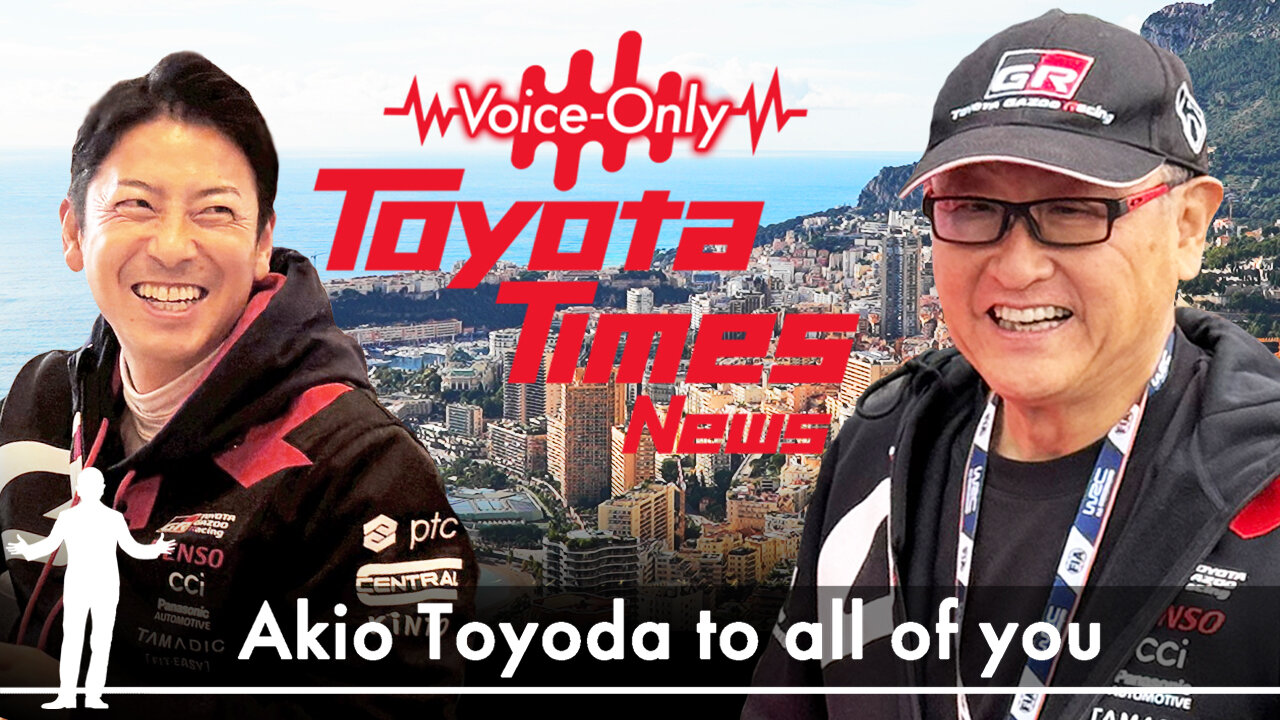
In Monaco, still buzzing with the excitement of the World Rally Championship (WRC), Chairman Akio Toyoda shares the conviction and responsibility behind his "three must-do priorities" in a compelling 40 minutes of candid reflection and heartfelt encouragement for the next generation.
The first Voice-Only Toyota Times of 2026 comes to you from Monaco, host of the World Rally Championship (WRC) Rallye Monte-Carlo, held January 22–25.
For Chairman Akio Toyoda, it was actually his first visit to Monaco.
His first impression of the city was an unexpected one:“Isn’t this like Atami?”
And he didn’t stop there. “After walking around, it’s more like Singapore.”
TOYOTA GAZOO Racing World Rally Team (TGR-WRT) got off to a superb start at Rallye Monte-Carlo.
But this episode goes beyond the excitement of the race.
As the intense competition is revisited, the conversation gradually turns to the “three must-do priorities” the chairman spoke about in his New Year’s address.
“Take bold chances. It’s okay to fail. When you give it everything you’ve got and still fail, the experience stays with you. Use it for the next challenge.”
Hard questions and quiet resolve to pass the baton to the next generation.
We invite you to hear the candid thoughts shared in Monaco.
Listen from the link below (Japanese only):
Listen to Voice-Only Toyota Times News on the following podcast platforms:
Spotify
Apple Podcast
Amazon Music
YouTube Music
Toyota Times, this time from Monaco!
Tomikawa
Hello to everyone listening to Toyota Times. I'm Yuta Tomikawa.
So today, you might be wondering where Akio and I are reporting from… We’re in Monaco.
Akio
That's right. We've been doing a lot from overseas lately. Didn’t we do one in Las Vegas before?
Tomikawa
Yes, that was a live broadcast, and I was able to join you there.
Akio
It just shows that Toyota Times is doing more reporting from around the world.
Tomikawa
We’re getting opportunities to cover stories globally.
Akio
And you're working on your English now, too.
Tomikawa
Yes, English… I used to not understand it at all, but now I can at least follow conversations.
I'm even trying interviews entirely in English now. Little by little, I'm still learning.
Chairman Toyoda’s First Impressions of Monaco
Tomikawa
Some of you listening might be wondering—why Monaco? When people hear Monaco, many probably think of Formula One.
Akio
For me, it’s the opening round of the WRC.
Tomikawa
Right, it's the same place where F1 races too. We’re standing near the start and the first corner of the circuit. This narrow road is where the F1 cars fly through.
Akio
Right. Through these really tight streets.
Tomikawa
And looking out toward the harbor, you can see so many boats. Wouldn’t it be great if a Lexus yacht sailed in here?
Akio
Actually, this is my first time in Monaco.
Tomikawa
Really?
Akio
That’s right, my first time ever. When I arrived, my first impression was, “Isn’t this like Atami?”*
*Atami: A seaside hot spring resort near Tokyo, known for its steep hillsides lined with hotels overlooking the ocean.
Tomikawa
I can see that. Coming here from Nice, it really does feel a bit like Atami.
Akio
And then when I went for a walk I thought, “Maybe it’s more like Singapore.”
Tomikawa
Oh, really?
Akio
In Europe, you really feel the history in the architecture. But some of it also feels quite new. Almost like Las Vegas.
Tomikawa
And there are people here from all over the world.
Akio
Also, whenever I come to Europe, I feel like I’m constantly being watched. I don’t really have much freedom to move around.
Tomikawa
Did you do something wrong?
Akio
No, I didn’t. But the moment I step out of my room, there’s security there, giving me that look like, “Where are you going?”
Tomikawa
That’s probably because they want to protect you.
Akio
Yes, but the way they protect me takes away all my freedom. So, I can’t really go out. I end up sneaking out early in the morning and taking a walk by myself. Otherwise, there’s no way to really get to know the city.
Tomikawa
It’s true. I’ve actually been here in Monaco for three days, but this is the first time I’ve seen you.
Akio
That’s because I’ve basically been stuck in my room.
Tomikawa
So, you’ve had that much work to deal with?
Akio
Not really. It’s more like being under surveillance, almost like house arrest.
Tomikawa
What do you mean by that…?
Akio
I’d like to know myself. I honestly don’t understand it. Even with the WRC, I only got an update last night when I met Haruna-san, the president of TGR-WRT OY. He just told me the current standings. That’s all I know. Nothing more.
The Rise of TOYOTA GAZOO Racing World Rally Team (TGR-WRT)
Tomikawa
Even if that’s all the information you have, I still have to ask. Oliver Solberg moved up to the top category this year, and he’s already driving incredibly well.
Akio
Yes, he really is impressive. But he did make a one-off appearance before, didn’t he?
Tomikawa
That’s right. He won in Estonia.
Akio
And of course, Elfyn Evans and Sébastien Ogier remain very consistent.
Tomikawa
How do you see this surge of young drivers? Speaking as the father figure of this racing family.
Akio
From the beginning, this team has had a very deep driver lineup. When we created the WRC team, we made it clear that we would be a drivers-first organization. It’s a team that is both like a family and highly professional. Last year, Ogier, Evans, and Kalle Rovanperä were all fighting for the world championship right to the end. Normally in a situation like that, teams issue team orders. But we don’t do that. It would be even better if there were more manufacturers competing, but right now, the top category is basically Toyota, Hyundai, and Ford. So, to make the championship more exciting, we try to keep the competition for the title within Toyota completely fair. Every driver prepares under equal conditions. Now, depending on the roads, the setup and preparation change. If every car was set up the same way and our prediction was wrong, then all the cars should struggle. But that didn’t happen last year, did it? Which means the team itself is very strong. At the same time, one of the three drivers fighting for the championship, Rovanperä, moved to Super Formula for a while. So, more young drivers are now coming into the team. Oliver is one of them, and Sami Pajari has also won in WRC.
And originally, Rovanperä himself entered the top category after winning in WRC. So now you have experienced veterans who compete at the very top of the world, alongside drivers who have just come up. I think that mix makes the competition very interesting.
Tomikawa
And even though they’re supposed to be rivals, when you go to the service park you see the drivers sharing information with each other. That’s really impressive.
Akio
I think that comes from the team operating fairly under equal conditions for many years. That’s what has built trust between the drivers.
Tomikawa
With Oliver driving flat-out, Monte Carlo has been exciting to watch. Even without much information, thank you for sharing your thoughts.
Akio
There’s only one way, you have to get the information yourself. And I think that’s true at Toyota, too. If you don’t go out and get the information yourself, nothing comes to you. People may think that because I’m chairman, all kinds of information naturally reaches me. But the reality is different. Our organization is divided into functional silos, and each one operates independently. Information goes to the top of those silos, of course. But if it doesn’t directly concern me, it doesn’t necessarily reach me.
Not Letting Toyota Become An Ordinary Company
Tomikawa
In your New Year’s address, you said your biggest mission is to develop leaders who will ensure Toyota never returns to being an ordinary company. If information remains within each function and doesn’t flow upward, does that mean the company risks returning to that?
Akio
Then the company does become an ordinary one. I can feel that happening. When I became president, the organization was divided into silos. Each function had its own executive vice president, and there was almost a gentlemen’s agreement between them. “Don’t interfere with my function, and I won’t interfere with yours.” I often used the example of an elephant. You want to move the elephant but one person says, “I’m looking only at the ears,” another says, “I’m looking only at the legs,” and another says, “I’m looking only at the tail,” then everyone is seeing something different. That’s why I started saying, “Let’s make ever-better cars.” Since then, many people have told us that Toyota’s products have changed. Each function still does its professional work, but we are evaluated by the car we produce together as Toyota. However, lately I feel the functional mindset may be getting stronger again. We may be developing people who can lead each function, but are they thinking about making ever-better cars for the 5.5 million people working in Japan’s automotive industry? Instead of saying procurement handles suppliers or overseas sales handles international markets, this is a B-to-C business. We deliver cars to customers. There should be people thinking about what we should do for all the stakeholders connected to that product. I feel there are fewer of them now. And to be honest, many Toyota people are not very interested in what I have done. Many think, “I’m the best,” and they want the chairman to recognize that and praise them. I feel there are quite a few people like that.
Tomikawa
That’s why, in your New Year’s address, you spoke about the three things you must do as chairman.
Akio
Yes. Some people say I’m still pulling the strings behind the scenes, or that being chairman isn’t really any different from being president. But I think I’ve stepped back quite a lot. Even so, the more I step back, the more I feel that when I’m consulted, the discussions stay within the boundaries of each function and don’t go beyond that. And that worries me.
Three Things the Chairman Must Do
Tomikawa
We also introduced this in Toyota Times News, where you said you had narrowed down the things you must do as chairman to three. I encourage everyone to take a look.
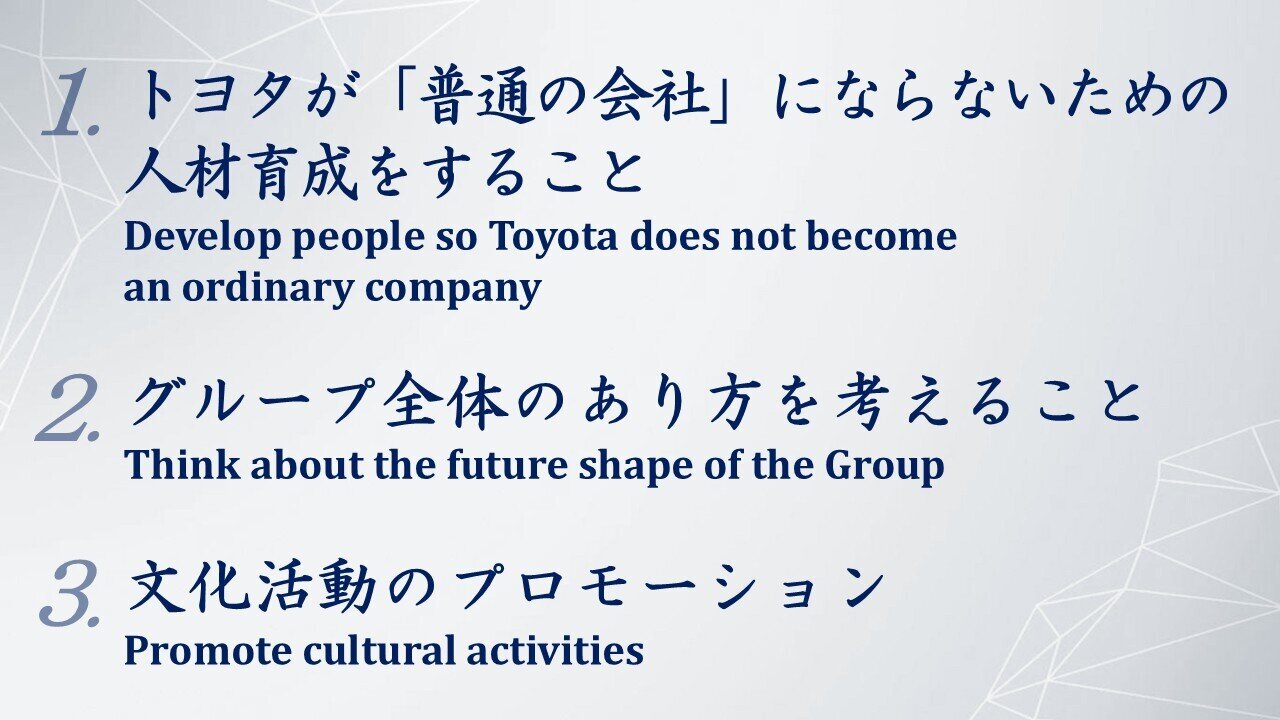
Those three are:
First, develop people so Toyota does not become an ordinary company.
Second, think about the future shape of the Group.
And third, promote cultural activities.
Akio
Rather than saying I narrowed it down to three, as I mentioned earlier, many people still think, “The chairman is probably running things from behind the scenes.” Even some employees think that. So I wanted to make it clear that what I’m working on now is the Toyota Group and developing the next generation of leaders. In a way, during my fourteen years as president, I may have ended up being something like a dictator. That’s probably how many people inside the company saw it. From my own perspective, it sometimes felt more like all the responsibility was being dumped on me. But the reality is, if there isn’t someone playing that role, a company as large as Toyota, where everyone works together to create products, simply can’t function. When that kind of leader disappears, the company can easily lose its direction. If people stop making decisions or taking responsibility, it becomes more comfortable to stay within each function, and things start moving in that direction. That’s why developing leaders so Toyota does not become an ordinary company is really about preparing for the post-Akio Toyoda era. Even after I’m gone, there must be people who can see the whole elephant. At the same time, there must be experts in each function. Some people seem to think I’ll always be here. But I won’t.
Tomikawa
You have very sharp instincts, and your antenna is always out there picking things up, so naturally people do end up relying on you. You describe yourself as a “dictator,” but if you mean this in the sense of setting the direction first and taking responsibility, that may be true. And that also created a culture where people felt encouraged to take on challenges, reflected in the idea of making ever-better cars.
Akio
You say that, but I’m not so sure that’s how it feels inside the company. I think many people still feel, “I don’t want to fail.” You probably feel you can say anything to me. But my sense is that for about ninety percent of people in the company, I’m still someone they feel hesitant to approach.
Tomikawa
Just so our listeners know, I’ll casually send Akio a LINE message saying, “I won the badminton tournament.”
Akio
That’s right. He’ll send messages like, “I’ve been asked to take on this kind of assignment. What do you think?” And I usually say this. In the age of AI, people may only work three or four days a week. The question becomes what you do with the other three days. Some people will want to work more, while others will spend that time on their hobbies. And I tell him, “You should lead the way.” But I’m not sure that message really gets through to others. When I’m overseas like this, I sometimes wonder if people don’t bring me information because they don’t want to risk making a mistake.
Tomikawa
But even if someone fails, you’re not the type to get angry, right?
Akio
The thing is, many so-called elites grow up without ever experiencing setbacks or failure, even from their student days. So even if you tell them, “It’s okay to fail,” they say, “No, no.” It’s almost like failure isn’t in their vocabulary.
Tomikawa
When I was at TV Asahi and got COVID, it felt awkward going back to work. But after joining Toyota, when I caught it again, Akio just laughed and said, “You must really be loved by COVID.” And I thought, “Wait, this is different.”
Akio
That kind of freedom should exist. But somehow, the environment I’m dealing with doesn’t really feel that way.
Tomikawa
So, for Toyota to remain true to itself, it’s about developing people who can see the whole picture. After all, no one can simply imitate Akio Toyoda.
Akio
There’s no need to imitate me. I always tell people to make better use of their own individuality, but maybe they still don’t quite believe that yet. Another issue is that Toyota’s training system tends to focus on what I’d call “Superman-style” development.
Tomikawa
Like someone who can do everything.
Akio
But being able to do everything might also mean being half-way at everything. In the age of AI, someone who can do a little of everything won’t stand out as much as those who can clearly say, “This is what I’m good at.” That’s where a person’s real value will show.
Tomikawa
It’s like a baseball lineup.
Akio
When you think about it that way, someone who can do a little of everything at sixty or seventy percent may struggle in the age of AI. If you’re going to do something, you either need to be truly top class at it or be willing to get your hands dirty. The people in between may end up with fewer opportunities to gain the experience needed to develop others. So before being replaced by AI, it’s important not to aim for being halfway at everything or trying to be a Superman, but to sharpen the one thing that defines your individuality. The one thing you can say is, “This is where I won’t lose to anyone.” And I don’t think there’s much time left to do that.
Tomikawa
So by continuing to refine themselves in their own “ba” or place, people will grow into the kind of leaders who can keep Toyota true to itself.
Akio
I think so. There needs to be a top management team thinking about how Toyota pursues ever-better cars. And each person should make the most of their own individuality. Different opinions are fine, but in the end someone has to decide. If we don’t keep doing that properly, I feel the company could slip back into being an ordinary one.
Tomikawa
That New Year’s address… it was possible because there was a place to share it directly with the people who chose to attend.
Akio
Actually, after I became chairman, no one invited me to the New Year’s address. Since I wasn’t invited, I didn’t go. But then I started hearing comments from the frontlines, including new employees, saying, “Why doesn’t the chairman show up?”
Tomikawa
People want to hear from you and meet you.
Akio
I’m not even invited to the entrance ceremony. But I started wondering if that was really the right thing. So this time I said, “Let me join for a bit.”
Tomikawa
Like the graduation ceremony at Toyota Technical Skills Academy.
Akio
The academy graduation ceremony is one where I say, “I’ll be there.”
Tomikawa
So maybe people wanted you to attend the New Year’s address and the entrance ceremony but just couldn’t say it.
Akio
I don’t know, but no one invited me.
Tomikawa
Maybe people are just holding back on their own?
Akio
I think that’s part of it.
Tomikawa
If you didn’t want to do it, you’d say no. They should just ask.
Akio
You’d think so, right? But maybe if their opinion is different, it feels a bit scary to speak up. I’m not sure. In any case, no one really says anything to me.
Tomikawa
You’re the kind of person who says, “Sorry I couldn’t make it,” to the point where we almost feel sorry for you. There’s no reason to think you’d get angry. I hope people listening to this program understand that it’s okay to tell you things directly.
Akio
I really hope people feel that way. You normally wouldn’t say this on the radio, but that’s the reality I’m in. Even this time I was thinking, “I’d love to go to the WRC.” Yet I kept wondering why no one brought it up to me.
Tomikawa
You’re busy, so when you meet the drivers, you’d want to know what’s going on beforehand. Otherwise, it’s hard to have a real conversation.
Akio
You can’t really have a conversation. It makes things difficult.
Tomikawa
So that covers the first of the three priorities, talent development. The second is thinking about the future of the group, something you’ve been emphasizing since becoming chairman.
Akio
I’ve been saying this for a long time. As it happened, there were various scandals across group companies. I’ve often been the one apologizing on Toyota’s behalf. But through that process, I was able to step into different group companies and work on rebuilding trust. And in the end, that turned out to be a good thing. At last year’s Japan Mobility Show, Daihatsu also exhibited as a wholly owned subsidiary. After the scandals, they had lost some of their energy, but with the mobility show and that commercial, it felt like employees started to regain their spirit. The mood began to shift toward, “Let’s try something interesting.” I think that may be the role I’m meant to play.
Tomikawa
Like that “fight” at the Tokyo Auto Salon.
Akio
Yes, that was intentional. I wanted to break the atmosphere where people felt they couldn’t speak openly to me. Recently, Executive Vice President Nakajima, who’s been getting quite a reputation as “Toyota’s Giaiano,” said something on that stage that really stuck with me. He said, “Of course there are people who want to build cars together with Morizo. But there are many more who want to make ever-better cars, even without Morizo.” And honestly, I completely agree with that.
Tomikawa
And Nakajima added, “I’m one of them.”
Akio
Yes, I hope a lot of employees heard that. You don’t have to keep saying Morizo or Akio-san just for appearances. If you’re making good cars, the truth will speak for itself. Here you have an executive vice president openly pushing back against Morizo and throwing down a challenge. That’s the kind of thing I’d like everyone to follow.
Tomikawa
Normally you’d think, “Is that okay?” But you seemed pretty pleased when you heard it. Though Giaiano wasn’t exactly looking you in the eye.
Akio
Giaiano wasn’t looking me in the eye. He was a little scared.
Tomikawa
But he said he’d win a trophy at WEC and bring it back to prove it.
Akio
I’d love to see that. If they win Le Mans and say, “We can win even without Morizo,” I’d be glad to hear it.
Tomikawa
In that sense, Europe is the home base of TR…
Akio
Here in Europe it’s GR, right? TR’s home base is in the U.S.
Tomikawa
The U.S.? Ah, right. There’s NASCAR too.
Akio
GR has rally as well, so it’s really more Europe-based. TR feels more like the U.S.
Tomikawa
So even if you ran into Giaiano (VP Nakajima) here, you wouldn’t let him call this TR’s home turf…
Akio
Well, he can say it if he wants. Go ahead.
Tomikawa
Thinking about the group as a whole, including Daihatsu and Toyota Industries.
Akio
In the past, there may have been a feeling within the Toyota group that Toyota Motor was governing from a couple of heads above the rest of the group. But in reality, that was often just someone from a particular function at Toyota Motor acting that way. When it comes to how companies within the group relate to each other, is that really the right approach? I feel that’s where my role comes in. For example, the Daihatsu commercial was created entirely by Daihatsu’s own employees. We’re doing similar things with other group companies as well.
Tomikawa
That’s great. It really brings the energy back.
Akio
Some group companies still refer to us as “Toyota-sama.” But it shouldn’t be “-sama,” right? Toyota Motor exists because the Toyota Group exists, and the Toyota Group exists because Toyota Motor is a member. It’s really about respecting each other and working together based on each company’s strengths. It may sound a bit idealistic, but that’s the kind of Toyota Group I hope to see. And that’s why I’ve started talking about culture. I think we need something to share beyond just work.
Tomikawa
When it comes to culture, initiatives like CEIPA and MOVEUM in Yokohama really emphasize carrying them out as the Toyota Group.
Akio
Yes.
Tomikawa
Hearing Akio Toyoda, who doesn’t exactly give off a cultural vibe, talk about promoting cultural activities across the Toyota Group, which also doesn’t necessarily have that kind of image.
Akio
Each company is already doing various social contribution activities. The thing is, people just don’t hear much about them.
Tomikawa
Was it around last year that you started talking about culture, Akio?
Akio
When I became chairman of the Automobile Business & Culture Association of Japan, someone asked me what our catchphrase should be. I thought about it quite a bit, and I felt that “turning cars into a culture” might be the most fitting role for the organization. That’s when I think I started speaking outwardly about culture.
Tomikawa
And that led you to think there might be things the Toyota Group could do together.
Akio
With music through CEIPA and art through MOVEUM, I thought that if we’re going to do it, we might as well do it together as the Toyota Group.
Tomikawa
So, these are things that need to be done while you’re chairman, and that will continue going forward.
Akio
My shelf life as chairman isn’t that long. While I’m here, I want to pass the baton to the next generation. I’m not sure yet what form that will take.
Tomikawa
But it does make sense. In terms of Japan competing with the world, and also in terms of children growing up and developing into people who can compete globally.
Akio
Toyota is a global company, so I think we’re already connected to the world. Take sumo, for example. I didn’t know this myself until recently, but it’s practiced in about 150 countries. And in each of those places, there are people who drive Toyota vehicles and many other stakeholders connected to us. So whether it’s music or sumo, when people are striving to reach the world stage, I believe Toyota and the Toyota Group can help support them.
Tomikawa
And when those seeds grow around the world like that, they make their way back to Japan.
Akio
I think it’s a way to make our presence felt in the world while remaining independent and building empathy with others. Talking about business can sound a bit self-serving, but culture creates a stronger sense of connection.
Tomikawa
Listening to you talk like this, it’s clear how much you love Japan.
Akio
I do. I really do.
For Someone Other Than Yourself
Tomikawa
I’ve heard a rumor that you suggested making February 24 “Toyota Culture Day.”
Akio
That’s the day of the U.S. congressional hearing back in 2010.
Tomikawa
Up until now, you’ve referred to it as “Toyota Restart Day.”
Akio
When you think about it, how many years has it been since we started calling it our “restart”? It’s important not to forget how we felt back then. At the same time, it’s been quite a long time, and there are people now who don’t even know about it anymore. Someone has to pass that story on. Back then, there was a sense within Toyota that we were increasing production numbers no matter what it took. We worked incredibly hard to rebuild trust and make sure we never went back to that. Even if we talk about those days now, many people today weren’t there. So, approaching it through something like culture, and ideas such as doing things for someone other than yourself, may resonate more naturally. That’s why I’ve been thinking it might be time to call it “Culture Day.” Of course, when you try to change something like that, there’s always resistance.
Tomikawa
That we must never forget that moment of restarting.
Akio
Or people saying, “This is the way we’ve been doing it.” That’s why I’m not saying everything should be changed, and I’m not saying everyone has to agree on one way either. First, this year I want to see how everyone spends February 24. I want to learn from that. And I hope everyone approaches it with confidence.
Tomikawa
I think it’s a really good idea. Rather than always looking back at the restart, it lets us look ahead through culture toward the future, helping children grow to face the world.
Akio
Yes. But many people don’t see it that way. That’s what makes it difficult.
Tomikawa
We’ve shared how you see things and where you want to go from here, so I hope people will take a moment to think about it.
Akio
Toyota people… at times like this, they immediately write a document for their boss. They drop in my keywords and say, “This is the chairman’s direction,” or “We’re thinking about the chairman.” As if they really understand. That’s not the point.
Tomikawa
There used to be those A3 reports too.
Akio
Any document, really. I used to say “a once-in-a-century transformation.” And then young employees would immediately write that into their materials. Their supervisors probably tell them to use those words. But that’s not what I mean. I want people to really understand the core of it. Even if the answer doesn’t come right away, they should think it through. Taking the long way is fine. I want people to find their own answer about, say, doing things for someone other than themselves.
Tomikawa
If you’re always thinking about how to help others, those words will come naturally.
Akio
When you help someone and see their smile, or hear them say “thank you,” you realize how much that can lift you up. People need to experience that for themselves. Doing something just because the chairman said so is no good.
Tomikawa
Sometimes it feels more like people want to be praised for doing it.
Akio
Exactly. I think that happens more often than we realize, at the core.
Tomikawa
So, the things that need to be done as chairman…
Akio
In any case, I won’t be able to do this forever. The real question is how much I can achieve within the time I have as chairman.
Tomikawa
While you’re still here to take responsibility, people should take on all kinds of challenges.
Akio
What I mean is, once I’m gone, someone else will have to take responsibility. Because I won’t be here forever.
Tomikawa
It’s a chance to get to the heart of it.
Akio
That’s right. Each person should find their own answer. It’s fine if the answers are different. But I hope people move forward, even if it’s just half a step or one step from where they are now. If everyone ends up thinking the same way, that’s not healthy.
Tomikawa
It’s okay to take on challenges.
Akio
Challenges always come with failure. And failure becomes valuable experience. Still, people don’t want to fail. To everyone listening, I mean this sincerely: it’s okay to fail.
Tomikawa
Everyone, it’s okay to fail. What matters is taking on the challenge.
Akio
This is another problem with Toyota people. They might start thinking, “If I fail, I’ll get praised.” It could turn into a parade of people showing off their failures. That’s not the point… It’s hard.
Tomikawa
I see. That would be a problem.
Akio
I suppose it just means things are pretty calm.
Tomikawa
It’ll be interesting to see what happens from here. If even a small change starts to appear in people’s attitudes, it would be great to hear you say on this program someday, “Ah, things really are changing.”
Akio
That would be nice. I wonder if that’ll really happen.
Tomikawa
Quite a lot of people listen to this program.
Akio
That’s why voice-only works so well. It makes people think for themselves. When there’s video, your attention goes to the visuals. With radio, you can really focus on the words.
Tomikawa
So listen again, with focused ears: “It’s okay to take on challenges. It’s okay to fail.”
Akio
When you give something your all and still fail, it becomes experience. Put it to use the next time you try. Life is long. Not like mine, where my future is already set. So take on challenges.
Tomikawa
Especially while you’re still chairman.
Akio
Take on challenges. Go for it. But someday I’ll be gone. When that time comes, stand on your own.
Tomikawa
Which means continuing to refine yourselves so you can stand on your own. That’s today’s takeaway.
Akio
Exactly.
Tomikawa
And with that, today’s program came to you from Monaco. At the beginning, I wasn’t sure how this would turn out.
Akio
We hardly talked about WRC at all. (laughs)
Tomikawa
Thank you very much.