



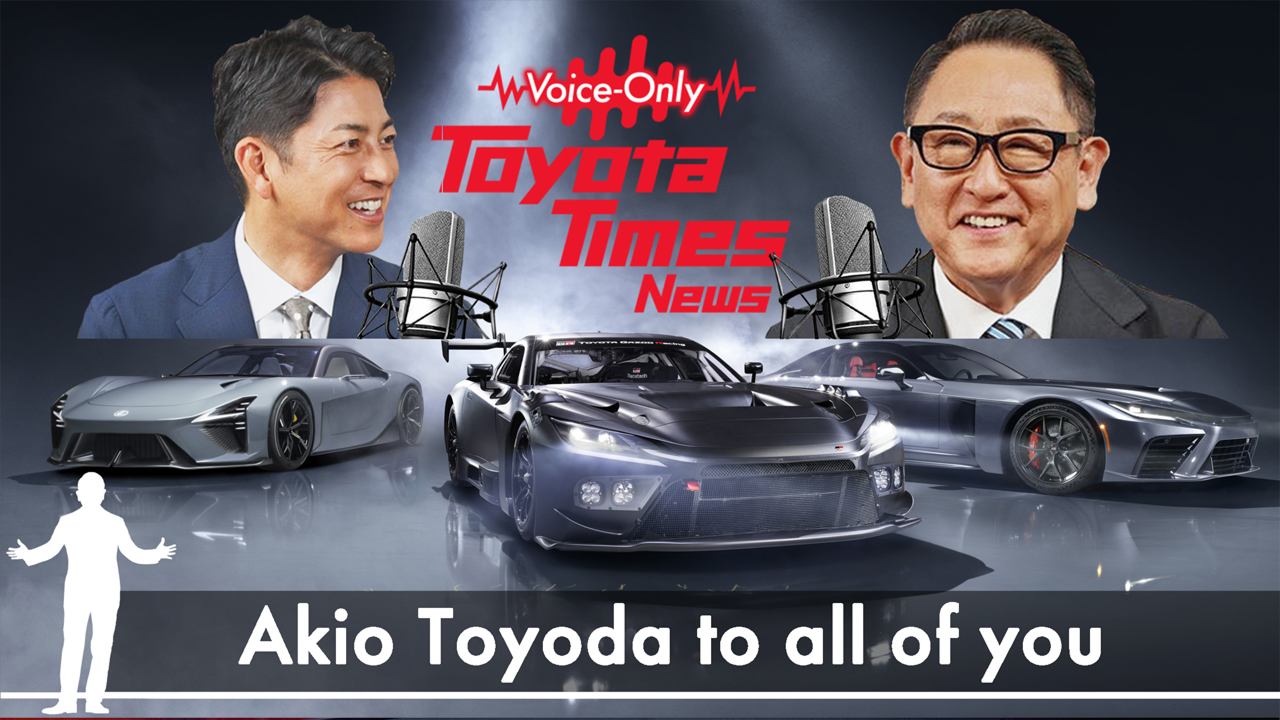
On December 5, the GR GT, GR GT3, and Lexus LFA Concept received their world premiere. Having been involved in development from the concept stage, Morizo shares his thoughts.
This episode of Voice-Only Toyota Times News comes to you straight from the source, recorded right after the GR GT, GR GT3, and Lexus LFA Concept world premiere.
Morizo likens the company’s sports car development to Shikinen Sengu*, the sacred ritual in which a shrine’s buildings are constructed anew at set intervals to pass down essential skills. Yet for a carmaker, this doesn’t mean simply making the same cars. As Morizo explains, Toyota’s Shikinen Sengu is about boosting the brand’s value by returning to the fundamentals of carmaking—what he calls the “secret sauce.”
*At Ise Jingu in Mie Prefecture, this sacred ritual has involved rebuilding the entire shrine and transferring the objects of worship every two decades for the past 1,300 years.
In his presentation, Morizo spoke of the people who have shared his journey, saying, “To these colleagues, I want to entrust our carmaking endeavor. And I want to keep making cars together with them so that our ‘secret sauce’ can be passed on to future generations.” On the podcast, Yuta Tomikawa tried to find out what exactly he meant by that word “entrust”…
Despite being involved in the development of these new models from the concept design stage, Morizo deliberately kept his distance from the project. As both master driver and chairman, he believes that encouraging the development team to take on challenges rather than making them seek approval is the best way to pass on skills today.
In our accompanying episode of today’s Toyota Times News, released at 5:00 PM, we showcase the world premiere presentations by Chairman Akio Toyoda and Chief Branding Officer Simon Humphries, as well as a talk session featuring development drivers, and Chairman Toyoda’s message to Toyota staff on the eve of the event. Of course, we’ve also captured the roar of that V8 engine. Alongside the podcast, the program offers insights into the development team’s vision.
Listen from the link below (Japanese only):
Listen to Voice-Only Toyota Times News on the following podcast platforms:
Spotify
Apple Podcast
Amazon Music
YouTube Music
Toyota Times, Broadcasting from Woven City
Yuta Tomikawa
Hello to all our Toyota Times listeners. I’m Yuta Tomikawa.
Today’s episode of Voice-Only Toyota Times is coming to you from Woven City. As always, I am joined by Akio. Thank you for being here.
Morizo (Chairman Akio Toyoda)
Thank you.
Tomikawa
We can see the Phase 2 construction vehicles. And snow-capped Mount Fuji looking beautiful, although it is a bit cloudy.
Morizo
It was absolutely stunning this morning.
Tomikawa
Yes, indeed it was.
As for where things currently stand here in Woven City, Phase 2 construction is underway, as I just mentioned, while residents have already started moving into the Phase 1 area.
Morizo
Yes.
Chairman Akio Toyoda’s First Overnight Stay at Woven City
Tomikawa
And you have stayed here yourself as well.
Morizo
There are rooms for short stays, and actually this was my first time to spend a night here.
Tomikawa
Your first stay.
Morizo
Yes. This past week, we had our WORLD ARIGATO FEST. which was held in Tokyo and at Fuji Speedway, so I could only travel at night. And since I had something here the next morning, I stayed overnight.
I get a great vibe from this place.
Tomikawa
Oh really?
Morizo
Yes.
Tomikawa
Well, Mount Fuji is said to be a mountain where the gods dwell, but aside from that sacred aspect, you felt that this area has a positive energy?
Morizo
I think it does. This site used to be a production plant, as you know. I imagine it contains all sorts of emotions—the past, the present, and now maybe even the future. So being here, I’m not saying that my sleep is anything to go by, but I feel as though I was able to sleep well because of the good energy in this place.
Tomikawa
Right. The fact that you were extremely busy and exhausted might have made for a good night’s sleep…
Morizo
That’s part of it, but it depends on the type of exhaustion. When you're mentally exhausted, you can't sleep. But when you've worked hard physically, you can go to sleep feeling happy and content.
But this week has been extremely busy and mentally draining, so normally I wouldn’t be able to sleep.
Tomikawa
That’s true.
Morizo
And yet I had a good sleep.
Tomikawa
Ah, I see.
Morizo
So perhaps I was more spent than usual.
Tomikawa
But the next morning, you were full of energy doing the presentation.
Morizo
I look bright-eyed, don’t I? You have to look full of energy. That’s the tough part.
You see, for me, I’m going nonstop, but the person watching only sees that moment. So, it would be disrespectful for me to go out looking exhausted because I’ve been going nonstop.
Tomikawa
Well said. That’s very true.
Morizo
It would be nice to have someone who truly understands that.
Tomikawa
Well, we do feel that, being so close to you—and it’s not just us. Others too, people who’ve spoken with you or heard your presentation…
Morizo
They were pretty pleased, weren’t they?
Tomikawa
People told me they were deeply moved and grateful.
Morizo
I’m truly grateful for that, and I think it’s good…
Tomikawa
So, we really do feel it.
Thank you.
Morizo
Thank you. There you go—you said it. I made you say it (laughs).
Tomikawa
No, no, no (laughs). I genuinely feel that way all the time. Thank you very much.
Why Woven City Was Chosen for a World Premiere
Tomikawa
Today, the world premiere of two new Toyota sports cars, the GR GT and GT3, was held right here in Woven City. To begin with, what did it mean to host the world premiere at Woven City? If I remember correctly, you were the one who decided to hold it here.
Morizo
Yes, that’s right. But I didn’t go so far as to say how it should be done. You see, quite a few of the people were also connected to Woven City. And above all, we had the WORLD ARIGATO FEST. at Fuji Speedway right beforehand, so timing-wise…there were people we wanted to see it.
Normally, world premieres are held just for the media. But since Toyota colleagues had come from around the world, we wanted them to see it too. Especially those who will be involved with these cars going forward—we wanted them to experience the place together with us.
At first, I thought it might be Fuji Speedway. But then I thought, since we have Woven City, why not have people come here and let our colleagues around the world get to know it. And since these aren’t the type of cars Toyota unveils all the time, I really wanted them to see the unveiling in person. So I suggested that we hold it at Woven City.
Toyota’s “Shikinen Sengu”
Tomikawa
When speaking of carmaking, you referred to the ritual of Shikinen Sengu, which at Ise Jingu means rebuilding the entire shrine every 20 years. In the same way, carmaking is also about nurturing Toyota employees as people, and that idea links directly to Woven City as a test course for the cities of the future, doesn’t it?
Morizo
Yes. You know with Ise Jingu’s Shikinen Sengu, every 20 years they wear specific garments for the occasion and perform set rituals for passing on skills. I think the idea is that, once every 20 years, you deliberately revisit what’s been decided, make sure it hasn’t been forgotten, and pass those skills on.
So if you think about it, in that sense it’s a 20-year cycle, like Shikinen Sengu. But in our case, we’re not trying to make the same cars.
Tomikawa
You’re right. That’s a big difference.
Morizo
Yes. We don’t set out to make the same cars, but rather to look at the fundamentals of carmaking, what I call our “secret sauce.” Given that cars are manufactured goods, it’s what keeps them from becoming mere commodities and sets each manufacturer apart, so that you can tell this is a Toyota and this is a Lexus, which boosts their brand value. I see returning to these fundamentals as a kind of Shikinen Sengu ritual for our sports cars.
I got to work on this “secret sauce” when I was just starting out as a test driver. And now I find myself in the role of master driver. Back then, the master driver was Hiromu Naruse. Twenty years on, I have taken his place.
So I ask myself, if this were Naruse-san, what kind of environment would he create for the people behind this project? And when I think about it that way, I feel these sports cars might be Toyota’s own Shikinen Sengu.
Reflections on Passing Down the Master Driver Role
Tomikawa
What surprised me was the closing of your presentation. You said you’ll keep on driving, you look full of energy, you’re active behind the wheel and as a leader of the company—and yet you spoke of passing on the master driver role and entrusting carmaking to your colleagues.
As I remember it, up until last year, you didn’t make much mention of what happens next.
Morizo
You see, when I inherited the master driver role, it was because we suddenly lost Naruse-san, the previous master driver, in an accident. As you just said, I can still drive, and I’m still in good health. So unlike that time, I’m not suddenly passing the baton to someone. And it’s not just from one person to another, but to a whole generation. I feel like the first step in the handover is to make people aware that things aren’t going to be this way forever.
Toyota’s sports car cycle, which comes around once every 20 years or so like our very own Shikinen Sengu, is a great opportunity to do that, to entrust people with this project and get them to think about the fundamentals of carmaking. As the chief engineer said, making a good car is ultimately about sticking to the ordinary fundamentals. It may sound obvious—but it’s not always easy to notice what should be obvious.
What’s more, I didn’t tell them what kind of cars they should make. The next generation had to think about it for themselves, and these are the cars they came up with. I’ve deliberately stayed back and not gotten too involved.
Morizo’s Role: Letting the Development Team Do What They Want to Do
Tomikawa
But what surprised me was that after driving the car, you spoke to the development team about things like how important that bubbling sound is when decelerating.
Morizo
Well of course. Going by Toyota’s regular benchmarks, no one would have said that was anything but noise.
That’s why I want to let them take on new challenges. Normally, if they build cars only by sticking to the existing formula, they won’t get into trouble—but if they stray from it, they will. If someone in my position, not only master driver but also chairman, tells them to make some noise, they can do it. After all, if you love cars, that’s exactly the kind of thing you want to try.
So as master driver, I think my role right now is to give them permission to do what they want. Allow them to take on challenges instead of seeking approval. I feel like that is my role at the moment.
Tomikawa
Everyone seems excited to come and give you updates.
Morizo
They do, don’t they? I think as development moves forward, it should gradually become more enjoyable for them. And in this day and age, that may be the right way to pass on not just skills, but ways of thinking. So I feel I’m being allowed to play that role, in my own way.
Tomikawa
I see. And having entrusted the process to others in this way, how did it feel to actually drive the GR GT and GT3 they’ve created?
Morizo
Well, I have driven them, but driving them properly will actually be next week.
Tomikawa
Ah, right. They’re still in the middle of development.
Morizo
They’re still in development, and it was in a very confined space—like a driving school.
Tomikawa
It looked pretty big to me, though.
Morizo
It was like a driving school. But next time, I’ll have a chance to give them a run somewhere more open, like Fuji Speedway.
Tomikawa
So then, Toyota Times will go and cover that as well, and at some point, we’ll share it with everyone. What I’m really curious about is how you’ll feel, Morizo.
Morizo
Yes, exactly. Of course, it’s important to keep taking on new challenges. But even so, there’s a kind of flavor, isn’t there? That flavor may change a little when the next master driver comes along. Still, I feel there’s a Toyota flavor that’s been there since before I became involved in carmaking—and that’s still there today.
As for Lexus, its flavor is still in the making. Century, on the other hand, already has a clear flavor, while GR is also still being shaped. And because I describe Lexus and GR as works in progress, I feel those two brands are ones we’ll continue to build together with the younger generation, going forward.
With Toyota and Century, there’s that sense of “this is it,” isn’t there? And somehow, I feel that’s something we need to pass on.
Tomikawa
But if Lexus and GR each keep taking on challenges in their own way, that also broadens what Toyota can be.
Morizo
I think it does. Just because they’re all part of Toyota doesn’t mean every brand should be making the same cars. After all, we sell more than 10 million vehicles, which means more than 10 million different customers. And to customers all around the world, we say, “TO YOU TOYOTA”—not “FOR YOU,” but “TO YOU.” So from the perspective of Toyota today, as we try to face each person as an individual, doing otherwise would be disrespectful.
Morizo on Being the “Disposer”
Tomikawa
I see. There’s one more thing that I’d like to ask you about car development in connection with this world premiere. As I mentioned during the talk show, through my reporting, Toyota’s current approach to carmaking centered around Morizo really feels like a one-team effort. And not just in appearance; people are truly working as one team. That sense feels even stronger in the development of the GR GT and GT3. The team seems even more unified. When I asked about it, I was told that it all began with a sense of frustration you felt, and that drivers and engineers then came together to first think about what kind of car they needed to build, and what it would take to win. I’ve also heard that starting development from a shared vision like that was a first for Toyota. How do you see this team?
Morizo
Well, I wouldn’t say I’ve been watching them all that closely.
Tomikawa
You’re looking at the cars that come out of it.
Morizo
That’s right. I’m looking at the cars themselves. As for how closely I’m watching the team that builds them, in reality, it’s not all that much.
Tomikawa
You started by laying out a vision, and then Daisuke (Toyoda) joined, along with the pro drivers…
Morizo
I haven’t really been told much about that side of things, either.
Tomikawa
You didn’t know? Really?
Morizo
I’m hardly told anything. My actions are actually watched pretty closely, but no one really comes to me with information.
Tomikawa
I see. So everyone’s thinking it through…
Morizo
Right, right. And I don’t say things like, “No one told me.” I suppose it’s because I’m trying to support them and help shape things in a better direction. But honestly, I don’t really know much about that side of it.
Tomikawa
What?! But you’re essentially acting as a backstop and people often refer to you as a “disposer,” don’t they…
Morizo
That’s why they call me a disposer. It’s like saying, “You handle the final difficult decisions,” or “If it doesn’t work out, you take responsibility.” For now, that’s still me. But once people can make those difficult decisions themselves and take accountability for them, then they can truly stand on their own.
But in that respect, it’s not about titles. I suppose they’re still relying on me.
Tomikawa
They are. And when you say “disposer,” it’s not like the kind you see in an apartment building. It’s more like a household disposer. At home, you can’t just throw things away, so they stay there, ferment, and eventually become compost. And from that, everyone…
Morizo
No, that’s not it…
Tomikawa
What, really! That’s not right?
Morizo
If you’re going to toss your trash my way, at least sort it properly. That’s what I’d like to tell them. I mean, people just toss it without thinking—that’s my two cents as a disposer.
Tomikawa
Really? From my perspective, it turns into compost from which new things sprout…
Morizo
I’m nothing as nice as that.
Tomikawa
(Laughs) No way…
Morizo
Really, really.
Tomikawa
That’s honestly how I see it, from my reporting.
Morizo
Honestly? From the disposer’s perspective, my thoughts are “Come on guys, use things more carefully.” That’s from my side, as the person dealing with what gets tossed.
Tomikawa
So the water and scraps go down together, it’s whirring away and that’s what you’re thinking about, huh?
Morizo
Yes, and there’s a sense that when something goes wrong, it all gets pinned on me, while the credit goes to Toyota Motor Corporation.
Tomikawa
Is that right? Oh my… I was thinking this would be a good time to wrap things up nicely, but that’s not a nice way to finish at all (laughs).
Morizo
But that’s the reality. Even so, I keep doing it. That’s why I say I’m the garbage disposal. And for now, I’m okay with being that.
Tomikawa
But in a way—and I know this isn’t the nicest way to put it—having a place where things can be left gives people a sense of reassurance, and that’s what allows them to take on new challenges.
Morizo
(Laughs) That’s what it is.
Tomikawa
They can tackle new challenges.
Morizo
Yes, because there’s a garbage disposal.
Tomikawa
Exactly. Without it, that couldn’t happen.
Morizo
Well then, maybe I’m not completely useless after all…
Tomikawa
For example, after the disaster, there are still interim storage facilities in place, because there’s nowhere for things to ultimately go. But that’s not the case at Toyota.
Morizo
Ah, so that’s what lets us move forward to the future! Good point.
Tomikawa
(Laughs) I’m doing my best here.
Morizo
Even a garbage disposal has its value.
Tomikawa
It certainly does. Thank you. I thank you on behalf of everyone.
Morizo
No, you’re right, it does have value. Definitely. Without waste disposal sites, that’s what happens, like the nuclear plant. But in our case, I’m here to handle anything and everything. Although I wouldn’t put it this way myself, I serve as the household garbage disposal unit, creating compost that becomes soil for the future. And then it is up to everyone else to sow the seeds.
Tomikawa
Ah, nicely put. Thank you.
And we can all look forward to seeing what kind of future Toyota cultivates, growing these seedlings into trees.
Morizo
That’s right.
Tomikawa
This time, the GR GT and GT3 came out of one such challenge, and although still in development, they’ve been unveiled for everyone to see. I wonder what kind of cars await us further down the road, and what the next cycle of Shikinen Sengu will bring. In the future, we are bound to see many new forms of mobility as well. There is much to look forward to.
Transformation Through the Pandemic
Morizo
In this day and age, after going through the pandemic, I feel we’ve changed into a company that can deliver products like these.
Tomikawa
That’s very true.
Morizo
I feel that the fact so much is coming out now really comes down to what we were doing during the pandemic.
Tomikawa
The fact that Toyota didn’t end up posting a loss during the pandemic is nothing short of a miracle. I was still at Hodo Station (news program) at the time.
Morizo
Yet the story became “revenue drops 80%.”
Tomikawa
That was one newspaper.
Morizo
But you know, that really came as a shock to me. It should have been a chance to boost Japan’s spirits—look, Toyota is still going strong!
What struck me was realizing that the media didn’t see it that way. I honestly felt that was unfortunate for Japan.
Tomikawa
At least for some of us in the media, we felt, “Toyota really is impressive.” And during the pandemic, beyond cars, there were things like protective gear and sanitizers.
Morizo
That wasn’t something I told them to do, either. It was the genba deciding they wanted to do something and took action.
Tomikawa
That’s great.
Morizo
During the financial crisis, nothing moved unless there were instructions from above. That’s the difference we’ve seen over time. Back then, we were deep in the red. This time, we’re in the black. I’d like someone to study that at some point.
By changing how we work and developing our people, we’ve come this far. Someone should really look into it.
Tomikawa
That’s true. Understanding how those changes led to today’s Toyota might make things clearer.
Morizo
Right? I’ve talked about making ever-better cars and been asked why I can’t give concrete numbers. But still, I’d like someone to study that.
Tomikawa
That’s why things have grown the way they have. And when you look at the numbers as a result, the difference is striking.
Morizo
Yes, exactly.
Tomikawa
Which kind of suggests that not focusing on the numbers was the right approach.
Morizo
No, I do look at the numbers. I really do. But when you lead with numbers, people end up chasing the easy answers and focusing only on the means. For me, management’s role is to say, “What’s our goal?” and “Which mountain are we trying to climb?” If you tell everyone exactly how to climb it, then it all becomes the same. And then where does each person’s individuality go? That’s the part I want to emphasize, but I suppose it’s not easy for a large organization to understand.
The Future Is Something We Create Together
Tomikawa
But when it comes to things like ever-better carmaking or becoming a mobility company, you’ve intentionally kept those ideas somewhat open-ended.
Morizo
That’s because everyone has the ability to think for themselves. My own ideas are really quite simple, you know.
Tomikawa
That’s interesting as well.
Morizo
What other people come up with makes it more interesting.
Tomikawa
So as a mobility company, including Woven City here, what new ideas are going to sprout in the future?
Morizo
Yes, yes, exactly—that’s for everyone to create together.
Tomikawa
That definitely gives us a lot more to look forward to.
Morizo
It does.
Tomikawa
With that, we hope everyone will look forward to what lies ahead for Toyota.
Morizo
That’s right.
Tomikawa
Thank you very much.