





Designers shape the look of a car. Toyota's Intellectual Property Division protects the many rights behind each vehicle. In the shared pursuit of ever-better cars, the two sides have built a bond that runs deep.
That bond came into focus again this year with the Intellectual Property Achievement Awards.
Established in 1987 by Japan’s Ministry of Economy, Trade and Industry and the Japan Patent Office (JPO), the awards honor individuals who have helped advance, broaden, and promote Japan’s intellectual property system, as well as companies that put IP rights to active use. It includes commendations from both the minister and the JPO commissioner.
For fiscal 2027 ending March 2027, Toyota was selected for the JPO Commissioner’s Award in the design category for companies making effective use of intellectual property. It was the first automaker to earn the distinction.
・Designs such as Lexus’s “Spindle Body” and Toyota’s “Hammerhead” gave each brand a consistent visual language and elevated that language into brand identity.
・Toyota secured protection for that work globally through design rights, while also obtaining trademarks, patents, and other forms of IP protection.
・Management, R&D, and the IP side have moved as one in putting designs, patents, and trademarks to work.
Those efforts helped bring Toyota the award.
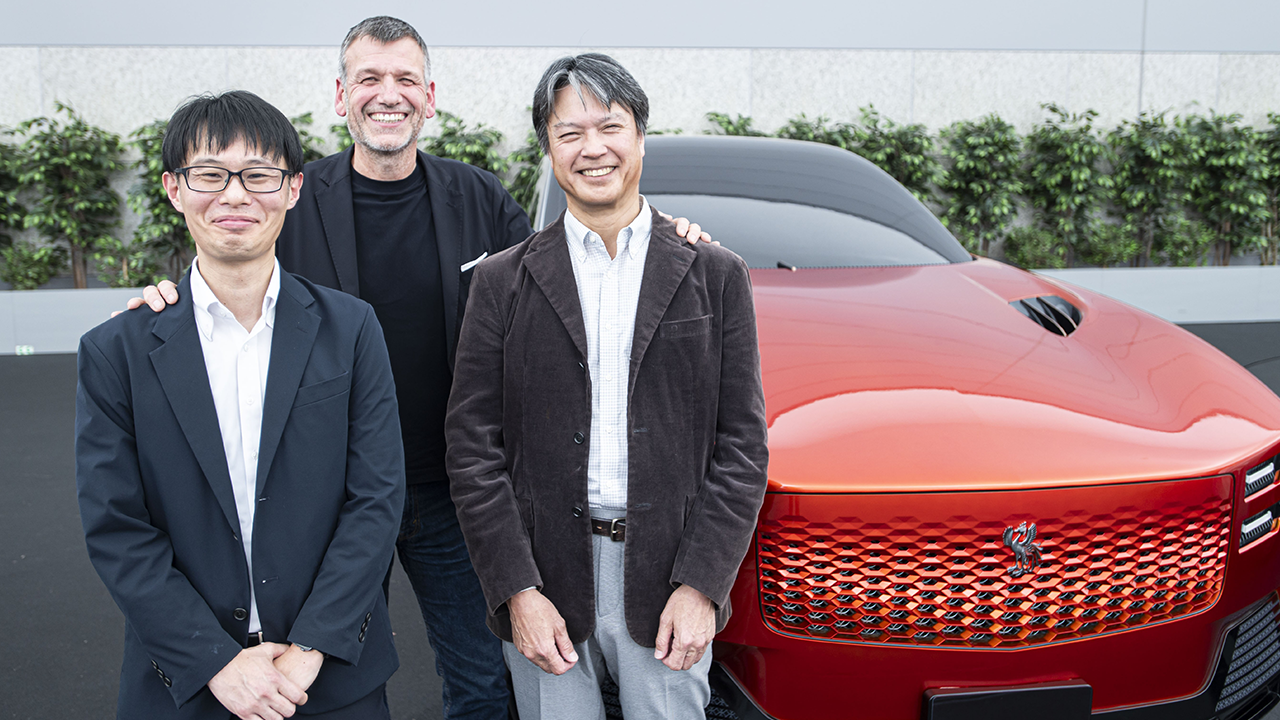
To understand what sits behind it, we spoke with Simon Humphries, Toyota’s Chief Branding Officer (CBO) and head of design, as well as Yoshikazu Jikuhara and Hiroki Hattori of the company’s Intellectual Property Division, who work each day to protect those rights.
Together, they reflected on the impact of Toyota’s Group Vision and brand reconstruction on design, and on what it takes to protect intellectual property in a meaningful way.
Conviction
Toyota Times last interviewed Humphries in 2022. Since then, Akio Toyoda has become chairman, and the Toyota Group has unveiled a new Group Vision: “Inventing our path forward, together.”
What have those shifts meant for design, and for the work of protecting it?
For Humphries, the Group Vision clearly reflects Chairman Toyoda’s strong conviction.
CBO Humphries

“I think the vision reflected the chairman’s strong determination to bring invention back to the center of the Toyota Group.
I felt very strongly that if invention is not at the center of the Group, there is no road ahead.”
In English, the Group Vision is rendered as “Inventing our path forward, together.”

That final word—together—is not there in Japanese. But for Humphries, it matters. A car is never the work of design alone. Suppliers, dealers, production teams, and many others across a wide range of worksites all have a hand in bringing it to life.
That is why, he says, “together” carries such weight. In his mind, the Group Vision, the brand reconstruction announced the following year, and this year’s Intellectual Property Achievement Awards are all part of the same story.
He describes that brand reconstruction as an effort to define, once again, the conviction behind each brand, placing Century at the top, followed by Lexus, Toyota, Daihatsu, and GR.

CBO Humphries
“Why does Lexus exist? What about Toyota? Daihatsu? GR? And when Century is part of that picture, what role does it play?
Once the conviction behind each brand comes into focus, the path toward shaping a concept becomes much clearer from a design standpoint, engineering included.
For Lexus, that leads to ideas like the six-wheeled vehicle and Catamaran we showed at the Japan Mobility Show. For Toyota, it leads to something like the IMV Origin, designed for markets like Africa.
That five-brand restructuring gave all of us—not just design, but engineering and sales too—the confidence to move forward with that message behind us.
And in the end, by joining forces with these wonderful people,” he said, glancing toward Jikuhara and Hattori at his side, “we were able to turn it into something real. That work mattered enormously.”
For Jikuhara and Hattori, too, Toyota’s recent changes have made their work easier to pursue.
Hattori

“We are not the department that defines the brands themselves. But when a design is created with that kind of conviction behind it, we secure rights by filing design applications.
Of course, we file for protection covering the whole vehicle. But we also ask designers which parts they see as distinctive, and by filing for those features as well, we work to turn them into protected rights.”
Jikuhara

“Once the brand is clearly defined, it becomes much easier to see what really matters.
The same goes for design rights. If you consider brand identity within a car’s design, it becomes much easier to pinpoint which parts are most important.
And once that becomes clear, it becomes far easier for the Intellectual Property Division to act. It also opens the door to securing design rights in ways that add even more value.”
Humphries put it this way: “The clearer a brand’s conviction becomes, the more distinctive the design becomes. And the more distinctive it becomes, the more it stands apart from everything else. Once that happens, you have to secure it properly as a right, or you cannot protect it. That is why design and intellectual property are all connected.”